
Growth expert leaderboard · Expert

Nir Eyal

· LinkedIn

12 insights on Product, Retention and Organic Acquisition from one talk or podcast, each with the quote and a link to the moment it was said.

Is this you? Suggest an edit

Product

Product

The “investment” is something you build into the product to make it better with use, and load the next external trigger. Habit forming products appreciate and get better and better as you use them, so you have to find a way to make the product better with use (“stored value”).

Growth Summit by Demand Curve at 8:05 · Featured in Growth Gems #63

Sylvain's take:

⛏️ Going Deeper: to put this into context, below is the hook model discussed.
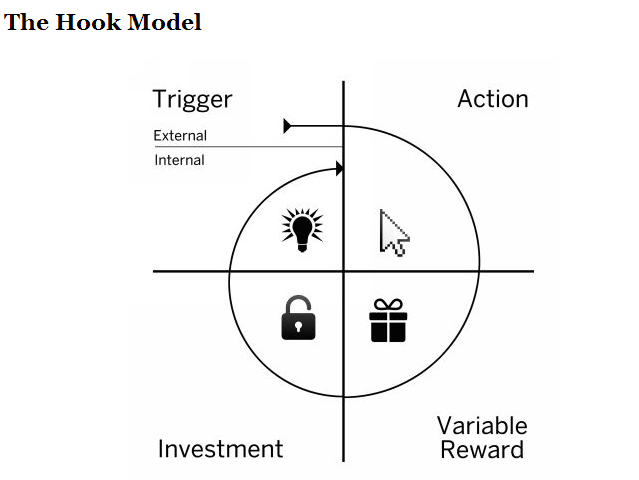
3 examples of the investing phase of the hook:

  • Games: getting players to rack up higher scores, to earn or tend to virtual goods (e.g. a farm, an avatar, etc.)

  • Airbnb (as a host): replying to messages, improving your home listing, etc.

  • Bottomless coffee: thought this one was pretty genius, as customers place their coffee bag on the provided scale so that the company always knows when they’re going to run out.

Product

If you’re looking at a two-sided marketplace, there might be one side where it does make sense to apply the habit-forming model. Example with Airbnb for owners: hook is uncertainty about who wants the property, action is opening the app/website, the reward is seeing what is the message (how much they’re willing to pay, etc.) and the investment is how much you invest on your Airbnb platform (changing listing, responding to customers, etc.).

Growth Summit by Demand Curve at 34:35 · Featured in Growth Gems #63

Product

Not every product has to be habit forming. The line of demarcation is not enterprise vs. consumer, it’s frequent vs. infrequent: if your product is not used frequently, you don’t need to form a habit in the product.

Growth Summit by Demand Curve at 32:05 · Featured in Growth Gems #63

Product

It’s crucial to know what the internal trigger is. You need to understand the psychological itch, the uncomfortable emotional state that gets people to come back to your product.

Growth Summit by Demand Curve at 22:05 · Featured in Growth Gems #63

Product

Gamification works if the internal trigger is boredom. It tends not to work because it tends to serve chocolate-covered broccoli: something we think people should eat, covered with something people love.

Growth Summit by Demand Curve at 23:10 · Featured in Growth Gems #63

Retention

Retention

You have to first understand what the internal trigger is for your users to form the habit, then craft the variable reward that scratches the user’s itch. Examples: boredom -> entertain; loneliness -> connect people together; stress/anxiety -> insurance.

Growth Summit by Demand Curve at 24:10 · Featured in Growth Gems #63

Retention

The most important thing to realize is that at an early stage, engagement is more important than growth. If you don’t nail engagement first, it will die down.

Growth Summit by Demand Curve at 18:17 · Featured in Growth Gems #63

Retention

If your product is not used frequently enough to build a habit, you can bolt on a habit-forming mechanism on top of the experience. This is done with content or community.

Growth Summit by Demand Curve at 39:32 · Featured in Growth Gems #63

Sylvain's take:

⛏️ Going Deeper: a few examples to illustrate adding this habit-forming mechanism:

  • Content - Williams Sonoma: buying cookware is not something that is frequent enough to build a habit. So they created a website called Taste with recipes, interviews, videos, etc.

  • Community - Y Combinator: applying is never going to be a habit but the HackerNews community keeps people around and keeps Y Combinator top of mind.

Organic Acquisition

Organic Acquisition

We think about the viral coefficient needing to be > 1, but we do not think about the viral cycle time (VCT): the amount of time that elapses between one person sharing your product to one person or more. If that time is longer than it takes people to churn, then you’re losing users.

Growth Summit by Demand Curve at 20:20 · Featured in Growth Gems #63

Strategy

Strategy

4 ways to capture the competition’s customer habits:

  1. Greater velocity through the hook: you need to find a way to go through trigger -> action -> reward -> investment quicker

  2. Increasing frequency through a change in interface (e.g. wearables, Alexa, etc.)

  3. Making the reward more rewarding (i.e. scratching the user’s itch better, which requires a 9x product)

  4. Making it easier to get people into the hook (e.g. Microsoft Office vs. Google Docs at the time)

Growth Summit by Demand Curve at 27:55 · Featured in Growth Gems #63

User Research