Growth expert leaderboard · Expert

Phil Carter

Founder and CEO, Elemental Growth / Subversive Podcast · LinkedIn

30 insights on Monetization, Onboarding and Activation and Product from 7 talks and podcasts, each with the quote and a link to the moment it was said.

Is this you? Suggest an edit

Monetization

Monetization

AI has fundamentally changed the cost structure of consumer subscription apps, making multi-tier pricing a necessity rather than a luxury. The emerging standard is a basic tier with limited AI access and a premium tier with full AI capabilities, mirroring B2B SaaS pricing models. If you have meaningful AI features, structure your pricing to protect your unit economics while using the basic tier as a funnel into higher-value plans.

"What you're seeing is more and more apps, Duolingo is a great example, are moving to a two-tier or multiple tier structure where you have a basic subscription plan that gives you non-AI features and maybe a taste of the AI power of the product, but you don't get full or unlimited usage. And then if you want the full-blown AI version of the product, then you have to pay for a pro plan or a max plan or whatever the tier is called. So, you're seeing this with Duolingo with their Duolingo Max product... Um, and then there are all sorts of other examples of tool. We've talked about 11 Labs, we've talked about Tol and like all these products have multiple subscription tiers, which used to be very unusual in consumer subscription, but it's becoming a lot more common because you have to protect against the underlying cost of supporting AI features."

The AI Growth Playbook for Subscription Apps – Phil Carter, Elemental Growth at 52:30 · Featured in Growth Gems #147

Sylvain's take:

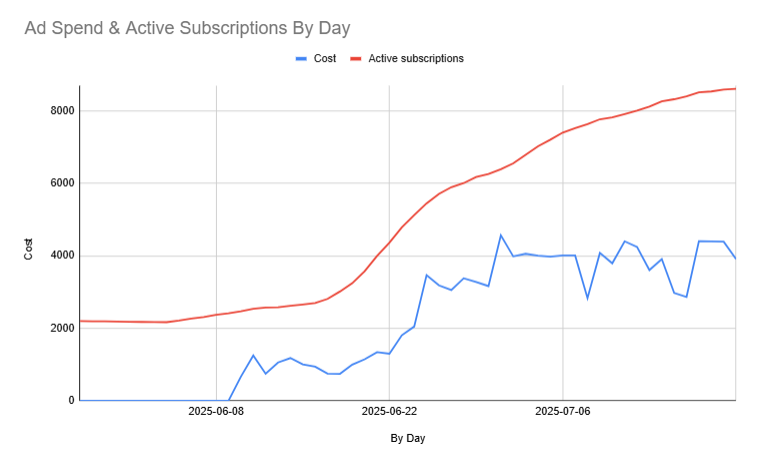
That AI creative I just mentioned had a huge impact in our revenue because we also offered a really attractive introductory offer in the onboarding. But as we expected, that aggressiveness with the price had a cost in the LTV, which got obviously worse although it was still enough to cover the incredibly low CPA that we could get.

However, there was one variable we had not accounted for: how the message of that ad directly impacted token consumption among users coming from that video. A cost that forced us to remove the introductory offer, build a paywall with 9 pricing tiers, and add stricter AI usage limits, all while keeping some options attractive enough from a pricing standpoint so we could still leverage on these good performing AI videos.
Monetization

AI apps face a unique trial design challenge: longer trials convert better but can be financially catastrophic when power users rack up massive compute costs and then churn. The industry trend toward shorter trials is being driven by AI cost economics, not conversion data. Carefully model your AI compute costs per trial user before setting trial length, and consider capping AI feature usage during trials rather than simply shortening them.

"You guys had in your latest state of subscription apps report this data point that called out that despite longer trials, trials as long as 14 to 30 days, often performing better on conversion, the majority of companies are actually trending in the opposite direction toward shorter-term trials. And I suspect the reason for this, if you were to cut it for AI versus non-AI apps, I suspect this is being driven largely by AI apps that are shortening their trials out of necessity because if you give away 30 days of free AI feature usage and you have whales racking up massive compute costs without paying you a dime and then they churn, then that's not a sustainable business."

The AI Growth Playbook for Subscription Apps – Phil Carter, Elemental Growth at 55:44 · Featured in Growth Gems #147

Sylvain's take:

The problem with the free trials on AI apps that run UA in channels like TikTok or Meta and optimize their campaigns towards this event is that algorithms don’t take into account trial conversion and just optimize on maximizing the volume of trials started.

This results in many users that just start the trial to use the app for free and see what’s behind the paywall but they never subscribe. These non-paying users will likely make use of all the tokens during the trial, increasing your computing cost while and shortening the LTV of the real subscribers that end up converting.

So before launching any UA campaign, run a thorough analysis of your AI compute costs against your pricing strategy and conversion rates, then calculate your target CPA with those costs already baked in. Sometimes you will need to rework your entire pricing strategy or shift your campaign optimization toward more down-funnel events to make the numbers work. Look at the available levers you can use to adjust the numbers while connecting your product and marketing strategy.

Monetization

Expand conversion among younger users by

  1. Being strategic with discounts (e.g., activity-based pricing or 2nd offers)
  2. Providing alternative payment methods like PayPal or Venmo, since many younger users don't have credit cards.
"If your marginal cost to serve a subscriber is close to zero, then being thoughtful around strategic discounts and potentially offering users who fit into certain demographics lower prices. Now, you got to be careful because there there are certain restrictions on that, but if you base it off of activity, and activity is correlated with age, then that's a way that you could better align your pricing with younger users who just have less ability to pay. And then another one is, um, sort of at the at the end of the funnel, making sure that you're offering alternative payment methods, or APMs, for younger users who literally may not have a credit card, right? And so, like, can you offer PayPal? Can you offer Venmo?"

State of Web2App 2026: Funnels, Pricing & Subscription Growth at 32:31 · Featured in Growth Gems #140

Sylvain's take:

For dynamic pricing, also check out Botsi (plugging all the friends today!).

Monetization

AI-powered apps face significant marginal costs for LLM compute, unlike traditional subscription apps with near-zero marginal costs. Web-to-app funnels become critical for AI apps because avoiding the 30% app store fee helps offset AI compute costs and maintain healthy unit economics.

"The underlying costs of using LLM to support AI features are non-trivial. So it used to be that the cost of supporting marginal subscriber was next to zero. If you think about Duolingo or Strava or Spotify, their cost to serve a marginal user is next to nothing. But now with these AI companies, you have to pay for underlying compute. And so that means you have to be more thoughtful about how much money you're getting back for every user you're acquiring and what your unit economics look like. And where web app comes into that is if you're avoiding 30% app store fees, then it's much easier to have healthy unit economics even with AI costs."

State of Web2App 2026: Funnels, Pricing & Subscription Growth at 6:14 · Featured in Growth Gems #140

Sylvain's take:

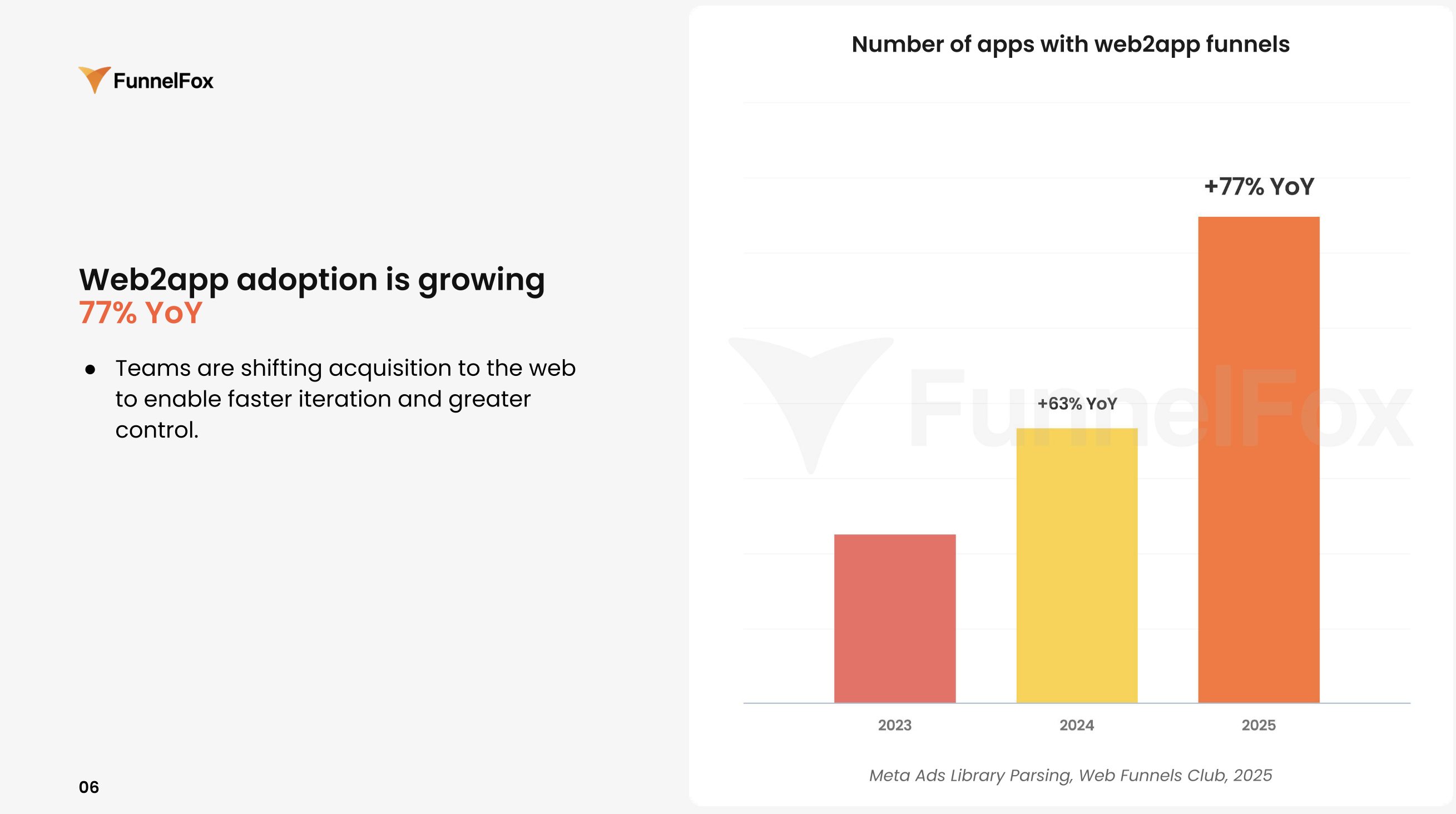
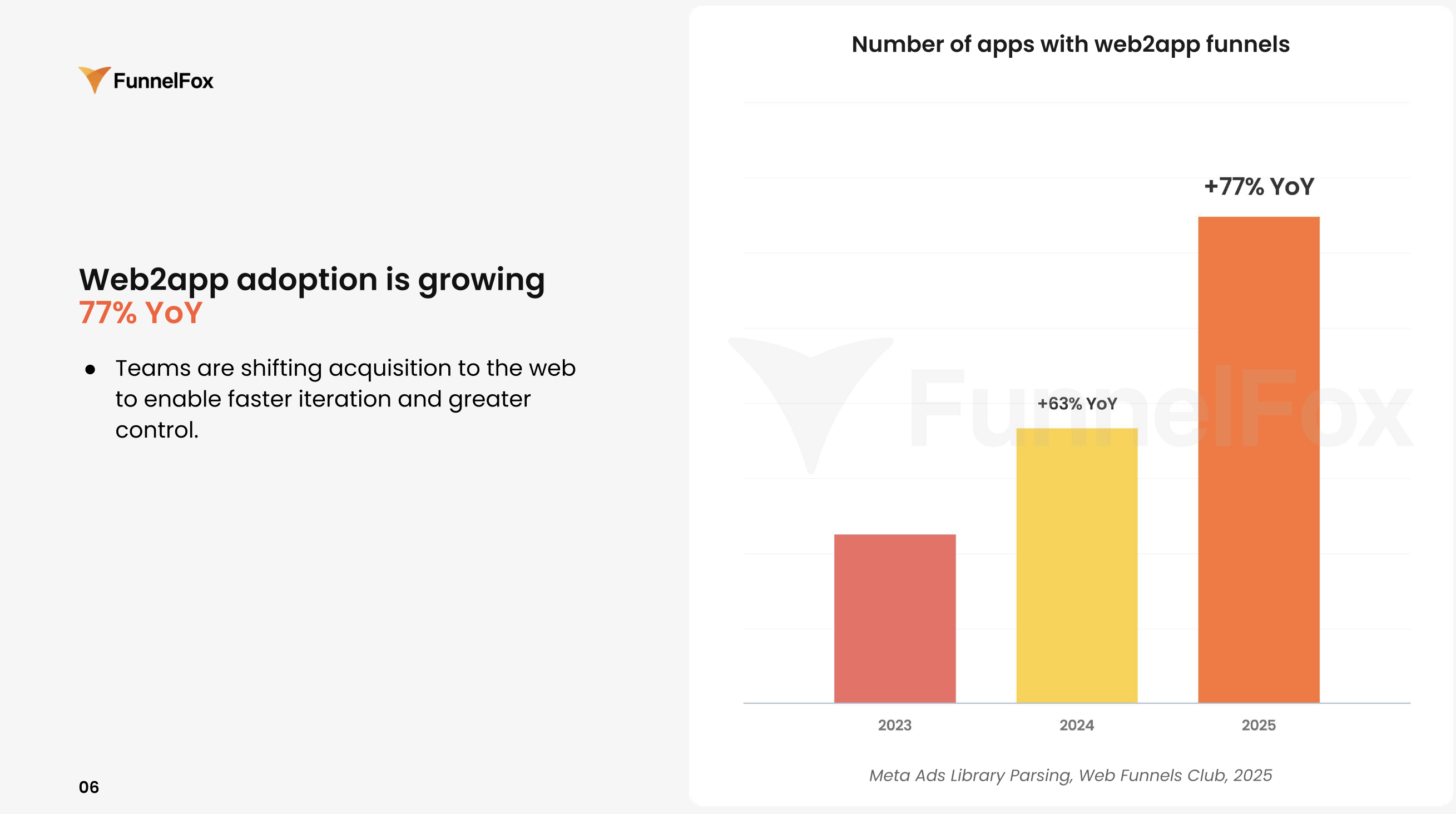
AI apps definitely must have helped the incredible growth web funnels have seen.

Source: State of Web2App 2026

On a related topic, check out Thomas‘ latest post Why hybrid monetization is the default model for subscription apps in 2026.

Monetization

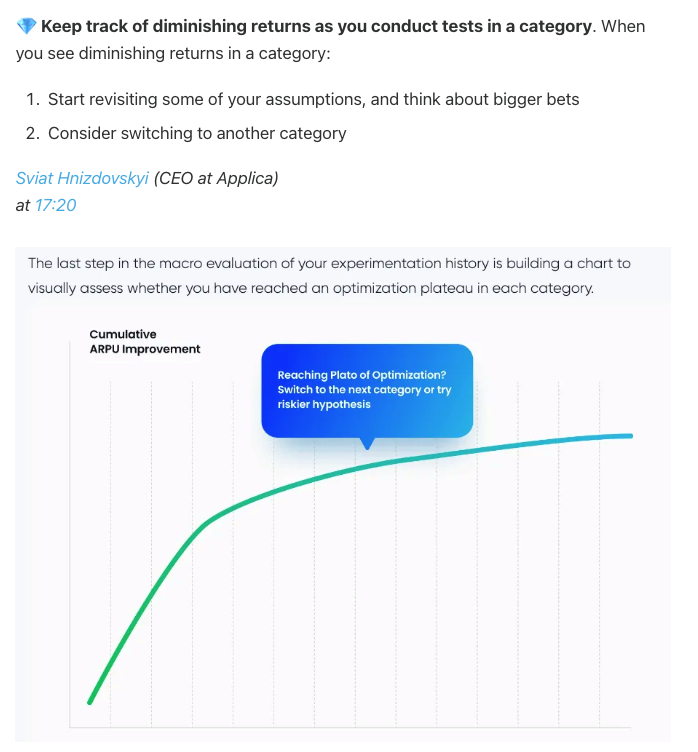
There's an "accordion" between:

  • Finding new growth opportunities with low-hanging fruits leading to a high experiment win rate
  • Not being able to get as many winning experiments and being in the "micro-optimization" zone which indicates you need to find new growth opportunities/areas

How Chess.com Became the World’s Top Chess App at 35:38 · Featured in Growth Gems #132

Sylvain's take:

This reminded me of the gem below by Sviat Hnizdovskyi (Co-founder at Applica), shared in Growth Gems #92 👇

Monetization

Customize the paywall for different entry points: the channel users came in through or other signals you have on users’ behavior. For example, if you enter Calm via Matthew McConaughey content, you will be displayed a paywall related to Matthew McConaughey.

The Subscription Value Loop: A Formula for Growth · Featured in Growth Gems #110

Monetization

Promotions are a tool to better align the value of your product with the willingness to pay of an individual customer so you can capture more consumer surplus. You have to be targeted and thoughtful about promotions. The companies that are doing this best:

  • Interject their brand and personality into seasonal promotions to stand out
  • Use activity-based discounts (e.g., offer a discount after the point where 90% of subscribers typically convert)
  • Segment based on demographics/psychographics to better align the price of your product with the customer

The Subscription Value Loop: A Formula for Growth · Featured in Growth Gems #110

Monetization

Value creation is the most important step - you need something people really want:

  • Robust: do you have the value promise that is solving a real pain point and has PMF?
  • Rapid: it’s hard to retain people’s attention. People need to understand why your product matters to them very quickly (within the first session, the first 30 seconds)
  • Repeatable: you need to make sure that the value promise is repeatable and that there are new chapters that bring users back in. Otherwise, there’s a point at which users have gotten most of the value.
  • Remarkable: you want a product that is unique and compelling enough that people will want to talk about it

The Subscription Value Loop: A Formula for Growth · Featured in Growth Gems #110

Sylvain's take:

The following gems dive deeper into these different points.


Robust

Onboarding and Activation

Onboarding and Activation

AI has opened a window to create magical first-session experiences that convert users within 30 to 60 seconds. With over 80% of trial starts now happening on day zero (and up to 90% in some categories), your onboarding must deliver immediate value or you will lose that user forever. Invest in AI-powered onboarding that hooks users instantly rather than treating setup as a chore.

"AI has created this window of opportunity for consumer app developers to create these magical experiences that can hook users and grab their attention and ideally convert them into trials or even directly paid subscriptions within the first session, and sometimes even within the first 30 to 60 seconds. And the reason that's so important is you guys reported data on this in your uh state of subscription after report... at that point, 2023-2024, it was like 70 to 75% of trial starts were happening on day zero. That's now over 80%, and in some categories it's almost 90%. So it shows that you really have to convert a user in that first session, or you're not going to convert them at all."

The AI Growth Playbook for Subscription Apps – Phil Carter, Elemental Growth at 8:03 · Featured in Growth Gems #147

Sylvain's take:

I wanted to bring up how AI has closed the gap between install and conversion, getting users to that valuable action within just a few hours in over 80% of apps. This means marketing strategy now plays a crucial role in connecting that first touchpoint with the user to the final presentation of your product during onboarding.

If both strategies — product and marketing — are not aligned, you will end up acquiring users who get lost during onboarding, never finding the “aha” moment they were expecting after watching that first ad you ran on TikTok or Meta.

Onboarding and Activation

Web-to-app funnels provide two critical advantages:

  1. Instant iteration without app store review cycles, enabling rapid A/B testing
  2. Deterministic attribution data that can be passed back to ad networks to improve campaign optimization and paid ad efficiency.
  3. Avoid app store fees
"I think the report did a really nice job of highlighting some of the obvious advantages to web to app. So there's the fact that you can iterate faster because you don't need a new app release cycle. And so it talked about how product teams, or even just marketing teams, if they're using Funnel Fox, can without a code change just go in and change the onboarding experience. So that's a huge advantage. I think another one is more deterministic data that you can pass back to the ad networks, which improves paid ad efficiency."

State of Web2App 2026: Funnels, Pricing & Subscription Growth at 16:35 · Featured in Growth Gems #140

Sylvain's take:

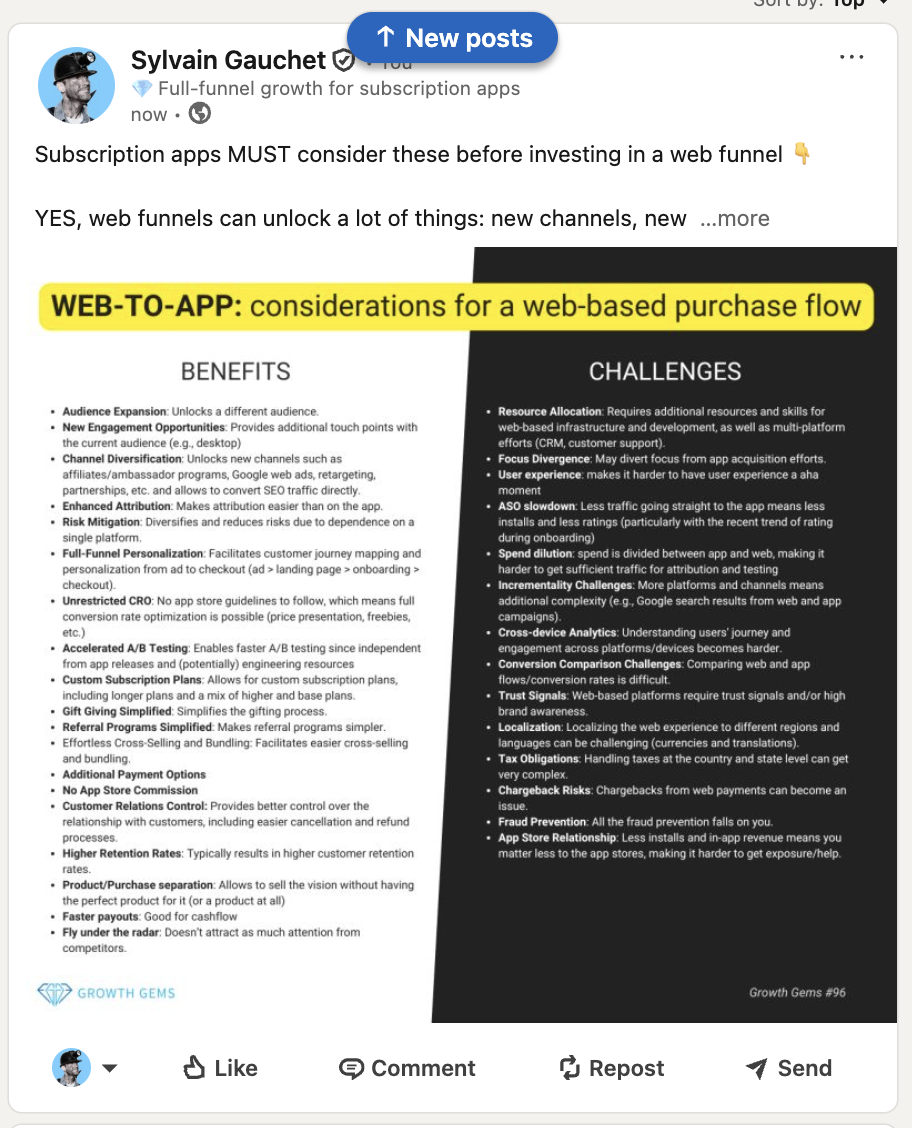
This was a great opportunity to update my Benefits vs. Challenges of Web 2 App (web funnels). Check out the post below (please comment/repost/save if you find it valuable)👇

Onboarding and Activation

Don't default to web-to-app for every product. If your core 'aha moment' requires native app features or is best experienced in-app (like AI companions), prioritize getting users into the app quickly rather than extending the web funnel. The medium should serve the experience, not vice versa.

"So much of consumer app success comes down to getting users to what's often referred to as the aha moment, the activation moment, as quickly as possible. And we talked about that earlier in the context of more than 50% of users are dropping off after the first screen, according to the report's data. And in some cases, it's much easier to deliver a wow experience in a native mobile app than on web. Not always. In many cases, it's about the same, but it's some like one of our clients is AI companion app called Tool, and they're doing some very revolutionary stuff with AI in the AI companion space. And so there are some things you can do on web, but some things that require native app features."

State of Web2App 2026: Funnels, Pricing & Subscription Growth at 17:30 · Featured in Growth Gems #140

Sylvain's take:

Phil gave the example of Tolan. App onboarding below.

Onboarding and Activation

People have seen things before they get to your onboarding. It shouldn’t repeat what they’ve seen on the App Store. Once in the onboarding: show, don’t tell: demonstrate how you will deliver the value.

The Subscription Value Loop: A Formula for Growth · Featured in Growth Gems #110

Sylvain's take:


Repeatable

Product

Product

AI-powered apps with chat interfaces have a natural advantage for personalization since the LLM response itself is the personalized experience. For non-AI apps, deep personalization works best when you can ask detailed questions (like fitness goals and experience level) that directly inform product personalization.

"I think where I'm seeing it, you mentioned, Marcus, obviously with AI apps where the interface is chat, it's much easier because you don't have a whole lot of UI Chrome that you have to customize. It's just the response that the LLM gives you. I think you're starting to see it a little bit in apps like Runna, for example, where because it's training for specific races and there's questions they can ask you about exactly what your goals are, what type of runner you are, what shape you're in, they can customize your workouts pretty significantly."

State of Web2App 2026: Funnels, Pricing & Subscription Growth at 7:17 · Featured in Growth Gems #140

Sylvain's take:

Andrey mentioned a couple of companies that personalize the product more extensively:

  • A fashion app using data about user’s style, favorite brands and appearances to tailor outfits for users inside the app

  • Medical-related apps using data from the quick to adjust medical recommendations and assign a doctor for online consultation

  • BetterMe which personalizes the app for different audiences (based on the funnel)

Product

It all starts by making sure you deeply understand as a company what your differentiator is. Whatever that is, index on that being the thing that you spend your highly expensive engineering technical resources to do it better than anyone else in the market. Are you a commodity? Do you have a product that no one else has? Do you have a technology? Do you have a particular process or access model? For everything else, try to find the best partner possible to put it on autopilot.

Best Practices in Subscription Funnel Management at 3:36 · Featured in Growth Gems #110

Sylvain's take:

Build vs. Buy comes back often in organizations. Ken’s take is pretty clear! He gave the following example to back this up:

No one in their right mind goes to their friend and goes, “Robbie, you have to buy a sub to the NYTimes because they process my credit card like nobody’s business”. But the minute you get that processing wrong, they’ll say, “Robbie, don’t bother.”

Product

Value creation vs. value capture:

  • Core product teams focus on creating core value for the user, with the primary metric being retention
  • Growth product work on capturing value as well as new user onboarding, with the primary metric being activation

The Subscription Value Loop: A Formula for Growth · Featured in Growth Gems #110

Sylvain's take:

To illustrate that value creation is not enough by itself, Phil mentioned the Spotify vs. Pandora comparison:

  • Pandora was an ad-driven model: it interrupts users and doesn’t have as much profit density (LTV/CAC ratio).

  • Spotify went all in on the subscription model, with a way to reinvest revenue in the core product.

Strategy

Strategy

As the app ecosystem becomes more crowded and attention spans shrink, the value of exceptional marketing has increased dramatically. Distribution and attention capture are now as important as product quality in determining success.

"I do think marketers have become much more valuable over the last five simply because the app ecosystem has gotten so crowded and people's attention spans have gotten so short that a really good marketer can make a huge amount of difference, and I think you've proven that with your work at Calm and Tinscale."

How Calm Added 1.2M Subscribers with Creative Marketing Tactics at 49:55 · Featured in Growth Gems #136

Strategy

The growth model looks different for every company. What you’re looking for is the Minimum Viable Model that really gets at the variables that are most leveraged for driving the business and tied to user actions: acquisition, monetization, and retention variables.

The Subscription Value Loop: A Formula for Growth · Featured in Growth Gems #110

Sylvain's take:

Phil shared you’re looking for the biggest bottlenecks in the business so you can find the highest leverage opportunities.

Strategy

Unless you have a very strong network effect (which most consumer subscription apps don’t), you can’t afford NOT to re-invest most of the value you capture into the product. Because if you don’t, someone else will come along and will leapfrog you.

The Subscription Value Loop: A Formula for Growth · Featured in Growth Gems #110

Organic Acquisition

Organic Acquisition

Even if you’re not a product that depends primarily on virality to grow your user base, you want a product that is unique and compelling enough that people will want to talk about it. Extreme examples: Tinder’s “Swipe” and Strava’s “If it’s not on Strava, it didn’t happen.”

The Subscription Value Loop: A Formula for Growth · Featured in Growth Gems #110

Organic Acquisition

The best consumer subscription companies have robust organic acquisition strategies that are their primary growth lever and only use paid ads as a supplement. It can be through word-of-mouth but also content. Example: Quizlet with long-term SEO, Alltrails with hyper-local search.

The Subscription Value Loop: A Formula for Growth · Featured in Growth Gems #110

Sylvain's take:

He also mentioned the different kinds of viral loops:

  • Personal viral loop - people inviting people to the product because it makes the product more valuable for them

  • Social viral loop - people are telling other people about the product early on because it increases their social status

  • Financial viral loop - people are inviting other people to get a monetary or non-monetary incentive (e.g., Masterclass)

  • Casual contacts viral loop - people use the app, and others see it (e.g., Strava at a marathon, Tinder at a party)

Retention

Retention

Ultimately, you want to build a sustainable habit with users. But you’ll never get there if you can’t tell them why they should use your app in their first session. Frontload as much delight and backload as much work as possible so users get to the aha moment as quickly as possible.

The Subscription Value Loop: A Formula for Growth · Featured in Growth Gems #110

Sylvain's take:

This is the eternal debate: is less always more? Some products, like Noom, ask users more questions to build more intent.

Phil also mentioned Rise as one of the best examples of onboarding because it demonstrates their coaching value: Within 2 minutes, you understand their value proposition and the main metric (sleep debt), you provide them with the minimum information, and you get a “magic output” (sleep debt over the last 90 days and recommendations).

Rise’s onboarding is also one of my favorites, not only because of its storytelling and how it educates users, but also because of how they got there: in Growth Gems #43 (June, 2021!), I shared insight from their CEO, including this one:

Branding

Branding

Don't neglect brand marketing just because it's hard to measure. Like retention and word of mouth, brand investment compounds over time and becomes a durable growth moat that performance marketing alone can't provide.

"I think a lot of VC-backed tech companies make the mistake of overinvesting in performance marketing and ignore brand marketing because brand marketing is just hard to measure. But over the long run... if you invest in brand and you keep your brand healthy over the long run, it has compounding benefits."

The Anti-Addictive Playbook Behind Pok Pok's 9X Subscriber Growth | Melissa Cash at 30:54 · Featured in Growth Gems #149

Sylvain's take:

Melissa later advised investing in brand (both company and founder personal brand) earlier than feels comfortable.

Pok Pok created a brand department to lead the "top of funnel" conversation around all the things that are important to Pok Pok. One thing that reflects this is their Instagram account:

They also recently did a partnership with Calm (cf. here and here):

https://www.instagram.com/reels/DaN7Z5jjwRB/

Creatives

Creatives

AI creative tools can take your paid acquisition from tens of concepts per month to 400-plus, and the benefits go far beyond lower CAC. The faster learning cycle from testing more creatives reveals what messaging resonates with users, which directly informs product roadmap decisions. Treat your creative testing program as a dual-purpose engine for both paid UA optimization and product-market fit discovery.

"Runna went from, you know, tens of creative concepts per month to 400-plus creative concepts per month that their marketing team is spinning off each month. And when you think about the implications that has for the company's growth trajectory, they're massive. Not just because more creatives leads to more ad testing leads to lower CASs because you're figuring out which creative is working faster and you're able to optimize and double down on your best performing ad creatives through networks like Meta and TikTok, but it also leads to more rapid learning cycle, right? You're learning more about your users and what resonates with them, which can inform product roadmap decisions in addition to just paid user acquisition."

The AI Growth Playbook for Subscription Apps – Phil Carter, Elemental Growth at 39:42 · Featured in Growth Gems #147

Sylvain's take:

Another high-correlated topic to UA and how the creative production systems have drastically evolved towards incredibly fast production machines thanks to AI.

We talked before how TikTok was burning the creatives much faster than Meta ads. In this environment, having AI to leverage the production of new assets increases the ability of marketers to prevent this fatigue in the short and mid term by testing more creatives faster and with more drastic variations in less time.

This is something that I already commented on in one of my articles on RevenueCat, where AI helped me decrease CPA by more than 85% with one single AI video (using an organic trend nobody was using in paid at the time):

Data

Data

Use predictive LTV based on quiz responses as a strategic tool for product development to prioritize feature development and product investments toward your most valuable cohorts.

"There's the value of PLTV from an ad optimization standpoint. And again, Marcus is the expert there and I trust him when he says that, you know, there's only so far that will take you, and in some cases it may even not be the best signal to send back to the ad networks. I think where it's definitively valuable is based off of responses to quiz questions. Being able to look at new users coming into your funnel and compare them to what you know are your best users based off of your own internal data over a much longer time horizon. You can start to figure out where the pockets of your highest value users are. And that can affect all sorts of things. It affects product development budgets like where you're investing in building new products, new features."

State of Web2App 2026: Funnels, Pricing & Subscription Growth at 44:53 · Featured in Growth Gems #140

Sylvain's take:

It can also mean you could define different CAC and ROAS targets based on the user segment.

Marcus also later mentioned it’s important to inform your creative strategy.

User Research

User Research

Conjoint analysis is a great supplement to Van Westendorp and helps you get insights into what they value most about your product. It presents users with a set of alternatives: 2-4 packages, each with attributes (price, number of usage-based, range, features you get or don’t get). Then, users go through tasks where they see those packages.

The Subscription Value Loop: A Formula for Growth · Featured in Growth Gems #110

Sylvain's take:

A conjoint analysis can help you with R&D (e.g., for what your product lacks), pricing (how to bundle, how to price according to users’ priorities), and sales & marketing (what to focus messaging on).

This HBS article gives a quick overview.

Conjoint Analysis example: determining what matters most for users in a tablet