The worst you can do is they force spend on every single ad. This approach wastes significant budget on ads that platforms won't naturally deliver to. Let the platform's delivery preferences guide your testing allocation.
"The worst you can do is they force spend on every single ad. They're like, 'Oh, I'm going to put $500 on every single one to validate that the cost per action is high or low.' This is the worst you can do. You're trashing a ton of budget."
Thomas doesn't even look at the ads before launching the creative test. That way he anonymizes the ads and removes the emotional component. He only looks at them after the test.
I guess that works if you're not involved in creating them :)
Both Thomas and Eric's point is that once in the BAU (Business Ad Usual) campaigns (your scaled campaigns), you won't be able to force spend anyway.
Paid UA
Demographic targeting is largely irrelevant, besides age. But even then, it's best to use a multiplier/value rule rather than fully exclude and instead:
Use creatives for targeting
Filter out the signal you're sending back to the network (e.g., Google) if you want to get less of a specific age range
"I believe demographic targeting is largely irrelevant. I mean, you target people through, we marketers, we don't, we don't really care how and sometimes even poorly done. I mean, when it's the category and interest on, like, or whatever it's called elsewhere, I think they're very relevant."
Thomas did mention that in consumer subscription, trial conversion is highly correlated with age.
Paid UA
It's not uncommon for non-gaming and subscription apps to have 20-25% of their budget going to AppLovin. But there are opportunities beyond AppLovin.
"For most apps I see going to the networks, they just go with AppLovin and that's it. They don't even try the rest until AppLovin is working. So I've, I've seen quite a few cases where they start on AppLovin, ended up scaling it to maybe 20-25% of the budget."
I've been surprised not to have seen a "Ask Amplitude AI" thing yet or something to spot patterns and opportunities in data. Turns out, they've been working on AI Agents (beta only for now).
I like something else Eric mentioned "the real value of AI will be for the stuff you don't see".
Paid UA
Meta's winner-takes-all ad delivery can prevent audience expansion since winning ads are only best for specific audiences so you should consider:
Running the same ad in parallel ad sets that have a different user personas (after a certain scale having 2-3 ads in parallel is not an issue)
Restrict placements for specific creative types (e.g., Feed for static and Reel for video) in the case where statics don't get spend vs. videos
"I think it's actually a bad decision from Meta to deliver this way because it prevents audience expansion. Like those ads, they may be the best, but they're only the best for a given audience. What typically happens in my case is I let it leave, but in some case when other ads have different user persona or they might be shown on different placement."
The first point helps mitigate the fact that Meta's winner-takes-all ad delivery can prevent audience expansion.
Paid UA
Implement a two-step creative testing process:
First, validate on which ads Meta wants to spend. Use a minimal budget, a lot of creatives together, and a top-of-funnel event (e.g., $100 with 50 creatives)
Then, test conversion performance on the top ones with more budget (e.g., 5)
This approach prevents wasting budget on ads that won't get delivery regardless of their conversion potential.
"One thing I do like to do myself, and I don't think it's super common, is to have a two-step testing. You need a bit of budget. It's not for the smallest budget where first I put very, very, very little money to validate that an ad can get traction, by traction is, Meta wants to spend on it."
This means you focus on delivery potential over conversion metrics in the initial creative testing (or even top of funnel metrics).
Thomas uses the same optimization event for both steps: the same one as what the main campaigns use.
Paid UA
Establish a minimum threshold of 10 conversion events per day for any campaign to ensure sufficient data for machine learning optimization. If you can't reach this volume, increase budget, change the conversion event, or don't run the campaign.
"I try to never run anything that doesn't have the potential to reach about 10 events per day. So the 50 per week Meta says about seven per day roughly. Me in my head, I put 10. There's not an exact figure, but like I basically calculate budget and so on depending on conversion rate."
As he puts it: "No machine learning is going to happen with two data points a day".
Paid UA
Never, ever rely on view-through for Apple Ads (and don't run Today Tab ads).
"Just don't do it. Never, ever don't do view-through on search. Like, it's not only Apple, like it makes no sense. And if it's view-through on brand, there's actually one case where I use them is that you can infer things, but I don't include them in my reporting."
Thomas did share a case where looking at view-through was useful. They changed the product page. For brand (with the first result in organic), they got a lower CTR and initially thought it was a loss. But by looking at the sum of view-through + taps they realized they were actually bringing more people to the page organically (and therefore paying less).
Paid UA
In the ad network integrations within your MMP, make sure you send events for "All media sources, including organic" because you're giving more signal to the platform to optimize. If you filter out, you're relying on the definition of "organic" of your MMP. Plus, someone not converting is also giving them signal.
Note: You then need decide to which extent you trust the ad network and MMP attribution.
"When mapping events on an MMP, I have the option to send all media sources, including organic. Should I choose this option? And then the same question for web to app as well. Yes. Head. Okay. And then that just gives you more data to break down and analyze. If you collect all that the the whole concept behind these signals that you send is you're going to you're going to show the platform. All your users with a bunch of parameters. Ah, this is my users. Uh and you're going to let the platform decide which they think are coming from their campaign. So the more user you restrict, the more parameters you restrict, the more restriction you put in. There, the more signal loss there is on the way, the least the platform can actually allocate properly. There is an argument to which extent they are actually honest with attribution and they're not trying to gain users that are not coming from them and so on. But this is not the question. If you restrict like what is organic like it's very hard to define like if you tell Facebook oh. No those you can't even see is that somebody else has made the decision that they were organic but maybe they were not as as organic as somebody else might say. So in my opinion you shouldn't restrict. Then you should be careful and not necessarily trust. What the platform is telling you but at least you should give it the opportunity to attribute and then make your decisions. So I'm not restricting and that's why I say the answer is yes.Yeah, in the end they need that signal. I mean also someone not converting is a signal. They can kind of base decision on. So like the more there is the better."
Thomas did add that you then need decide to which extent you trust the ad network and MMP attribution.
Paid UA
Modern ad targeting doesn't work by manually selecting demographic interests. Instead, platforms determine who to target based on two inputs from marketers: the creative assets and the business goal signals (and in the future, maybe just the latter). The platform then uses these to find the right audience.
"And very often I get questions from people outside this industry, like they think as marketers will, like, run in targeting of, like, "Oh, are you using interest?" And "Oh, are you targeting women between 20 and 40 in Colorado who like fashion?" I'm like, "No, I'm never doing that." Like and and I think here it's it's quite interesting in the in definition of what we're talking which is as marketers, the main level we have to tell the platform who to target, which is which user to show ads on, their the content of the ads, and the platform is smart enough to deal with who's going to be interested based on who interacts with it, and this signal, which is what do I want as a business goal, and they make a mix of it like between the creative and what I call the signal."
For Google Ads, it's not clear if there's an advantage in using Firebase events vs. MMP events for campaigns in terms of actual optimization. However there are features like value-optimized campaigns and soon ODM (on device management) that only work with Firebase events.
"Google claims that Firebase is very much better than an MMP for for Google ads. Uh I fought this claim for a very long time. Funnily the thing is at the difference of meta. Google is gating some feature on sending through Firebase. So for example the value campaign you can only do it through Firebase. You can't do with J. MMP. So if you want to do that, you'd use Firebase. Uh you can when you send via. Firebase use some kind of audience layering that you can't through an MMP. Uh. So there's a bunch of like whitelisted feature with Firebase which tends to me to think that yeah that's great to send through Firebase because then they I have access to these features. Mark has also mentioned before like less intermediary the better. So that's actually a good reason to believe Google when they say that it might be better to have the signal directly from Firebase because there's just less inventory less less intermediaries. So that's great. So far personally I haven't found as much difference in performance when you run event optimization. Uh I know a couple of people have seen it. It's not so easy to determine precisely. There's one very recent development that's coming. It's a new feature that's coming soon that's called ODM on device management where Google will officially fingerprint with the IP address. But it's legit because they do it on the device not on their server which we can debate about it. But it's not a question and I think this could be really something that give Firebase an edge over MMP but that's a future thing. I have zero evidence today that using the MMP is detrimental to your performance."
In most cases, have your creative testing campaign optimize for the same event as your scaled campaign. Only use a different event (e.g., install) if you validated that you can attract the same audience, not only in terms of demographics (age, gender, device, placement) but also behavior.
"I used to do it, I don't do it anymore. And for the same reason we just discussed here that different events can attract different audience. But then if I'm running the so. It's obviously cheaper and you get the signal faster. So it's tempting to go on creative testing for for install. If you can validate that this audience looks like the same as you're actually trying to attract and not only in demographic in age and placement and and I don't know gender and device but actually in the behavior. Yeah, that would be a great option. But in in practice, I've seen very often those installed campaign bring a completely different audience. Sometimes good for audience expansion, especially when I'm trying to I'm starting to see fatigue inside like the core audience and we're like what creative works for other people and then we'll figure out how to monetize them. Uh but in most cases, I'd rather have my creative testing run on a very similar event so that the audience are more alike."
Same thing is true by geo: validate your creative testing setup.
Paid UA
Signal engineering is about designing the data you share with ad networks to optimize campaigns. Instead of using basic approaches like 'bring me all subscriptions,' you can get smarter about what signals you send to platforms to significantly improve performance.
"What we're talking about here is about thinking and designing the the data that you're sharing with that networks for to optimize campaigns towards. So the the signal is what you tell Facebook, Google, TikTok, hey, I want more of this. And I bring the topic first because I think it's it has layers in it and it's quite interesting, but also because I'm seeing most people have a very basic approach of it like hey yes all my subscription bring me that and and I think there are ways to get smarter here and get better performance."
AEM works without SKAN, but also having SKAN properly implemented helps you compare campaigns on the same criteria via Meta's attribution settings.
"Any hints as to whether scan does help or or do you think Facebook's documentation is correct that it's not actually taking that into account? Even if it doesn't help, it can't hurt. So, I see no reason why not having a proper scan uh setup. Let's say it has zero impact on the optimization like Facebook claims. And it's a very real possibility. At least it gives you the the option to compare. You know, you have the attribution settings where you can look at the scan campaign. Maybe you can compare a scan campaign and an AM campaign on the same criteria because then you have the second column. So, personally, I see I don't see any case where it's going to hurt. So, why not have it? Because it's it's giving you potential reporting and potential other campaigns to run even if it doesn't improve the AM performance."
Your product analytics are typically the place where you'll dive deep to analyze engagement and conversion/revenue behavior for different segments in order to determine how you can fine-tune signal (bigger companies might have a data warehouse for that). Make sure you integrate subscription event and revenue (e.g., from RevenueCat) in your product analytics tool (e.g., Amplitude, Mixpanel).
"So that's typically wouldn't be in the MMP because they don't have all the layers of criteria that I want to add like. They don't have the answers to the the on boarding until I program them because I need it. So typically you wouldn't you can filter a few things like device and all but that wouldn't be the normal. The most normal place is product analytics so that would be amplitude omix panel. Hopefully. You're well connected with re cat. So you have all information of behavioral but also how the subscription react because obviously it's not a natural that amplitude is going to have all the the the renewals the console oh. It's not a product and so on. So if you have things set up properly between revat and product scient is definitely the place to go. There are bunch case where we actually do it in our own data warehouse. But those are sophisticated clients that have like very like big data warehouse where everything is to probably it's the way Dualingo would do it and it's the way a maximum of one or two person in the chat are going to do it like I'm not saying. It's not a recommendable way to do it. If you can. But the the most common answer is going to be. This is going to be no or big spanel. The the small reality behind it is that I'm never the one doing it. I'm telling you. I'm telling what I want and I have a data analyst doing it. So the truth is I very rarely do that myself. I sometimes go because I see the datalist didn't analyze one or two criteria that I've seen elsewhere be one that is discriminating. So I'm going to get into amplitude and I'm going to make my filter but most of the case I'm not even the one running. M"
Avoid mixing signal sources (like using both an SDK and MMP simultaneously) especially in early stages. This often leads to deduplication issues, filtering problems, and messy data that can significantly impact campaign performance.
"I work with a bunch of other people who like see accounts, and many people would have the SDK and an MMP both sending conversion at the same time, and there are ways to make this work great, and there is the duplication and so on, but very often, especially early stage, when you start mixing sources and like not the same thing arrive under different name, there's filtering happening, and the deduplication is not necessarily perfect. Different networks are good or bad with the duplication as well."
The fundamental tradeoff in signal optimization is volume versus quality. Even with small budgets, you can usually optimize for events deeper in the funnel than installs. Aim for at least 10 events per day per campaign for stable performance while maximizing quality.
"The main tradeoff is volume versus quality. So it's extremely likely that even if you're a small advertiser, you've got enough volume that you can optimize be beyond an install. Like this is there might also be reason to run install optimized campaign and maybe Marcus would quote one or two, but in most cases, even if you have a little. Marcus would quote one or two. But in most cases, even if you have a little budget, not a lot of volume, you may find an event that is lower down than the install."
Be cautious when filtering out users who immediately cancel auto-renewal. Many of these users might actually convert later, possibly on different subscription products. What appears to be low-intent behavior might actually indicate savvy users who eventually become high-value customers.
"I stopped using the auto console not for this technical reason, but for another reason, which I'm going to get into, which is I realized that later that a lot of people who auto console were actually ended up converting, but I wasn't seeing them because they were converting on another product. I have a subscription product in the onboarding, and if you don't convert there, later in the app I've got different subscription products, like we are offering different types of subscription and we never realized that actually a lot of the auto consellers, yeah, they don't want to be caught by the by the the purchase happening without notice, but a bunch of them, they love the app and they end up conselling on another thing"
Look at your data to figure this out: to which extent do early cancellers end up bringing revenue? If your engagement/retention is on the stronger side, it might be the case.
If you determine that they don’t, then the way Marcus later mentions he determined the cancellation window to filter out trialers is by making sure you filter enough of them out. For example, 10% of trial cancellers within 10 minutes and 30% after 10 hours (and chose 10 hours).
Thomas also later explained that events like a “qualified trial” are not as straightforward to trigger when they use signal that can only be detected server-side because you have to withhold the event until it meets the condition.
Paid UA
Marketers have three main levers for campaigns: creative assets, budget/bidding, and signal (the data you share). While creative gets most attention, signal is one of the last powerful levers we have but is rarely discussed despite its significant impact on performance.
"So we've got three main levers, and obviously creative is a huge one, and there's a ton of things to do there, and there's lots to talk about, not for today, uh, in format, content, and more. One is the budget and potentially bidding. Bidding is a bit more complicated than that, but, uh, obviously you can still tell Google if you have 500 or or or 5 million to spend. Uh, but the last one is actually the signal, the data that you're sharing, where you're telling the platform, "Oh, I would like to generate more of this, more installs or more clicks or more trials or more revenue or more whatnot." And I think here there's been very little conversation where it is one of the last levers that we have."
Instead of filtering positively for your best users (which limits volume too much), filter negatively by removing your worst users. This maintains sufficient volume for the algorithm while improving quality, making it more effective for scaling campaigns than trying to target only your top-performing segments. Same thing here: you can figure out the onboarding questions that could allow you to filter out users.
"At the beginning I made the mistake that was like trying to identify the best user, the best audience and send that to the network. The problem is that very often your best users, there not enough of them. So I was filtering for, let's say, the top 10% of users or whatever, which is also great research to run anyway. Know what do, what differentiate them, how they behave differently, what they answer, and it's going to inform you a lot of things you can do in your product, but from a UA point of view, I'd rather think negatively, which is instead of looking for the best users, I say, what characteristic do the worst user have, the ones that always cancel no matter what, like which question?"
Ad platforms literally give you what you optimize for. If you optimize for clicks, they'll give you cheap clicks that don't convert. If you optimize for installs, they'll give you installs that don't convert to trials. Always optimize for events that align closely with your actual business goals.
"So basically the way I see it, the the most advanced platforms, so that would be Meta and Google, they're really good at giving you what you ask for, meaning let's say you say you want to optimize for clicks, they give you a ton of clicks for a very good price per click, but they're going to cherrypick the clicks that are least likely to convert from a click to an install, from a click to a sale. Why? Because you ask for a click, so they're going to give you the clicks that other people don't buy, which are the ones that never convert."
Funnel metrics are very different per acquisition channel (e.g., paid social vs. ad networks, sometimes even on the same channel based on optimization events and placement). Some of this is due to differences in measurement, but there are also different contexts. If you’re at scale, you might want to have a strategy where you both:
Go for a more expensive audience that converts more
Go for cheaper inventory that converts less so you can expand your audience
Go for a more expensive audience that converts more
Go for cheaper inventory that converts less so you can expand your audience
Funnel metrics are very different per acquisition channel (e.g., paid social vs. ad networks, sometimes even on the same channel based on optimization events and placement). Some of this is due to differences in measurement, but there are also different contexts. If you’re at scale, you might want to have a strategy where you both:
Go for a more expensive audience that converts more
Go for cheaper inventory that converts less so you can expand your audience
Thomas shared additional data and recommendations in his talks at AGS and Organic Party. You can check out his slides here.
Paid UA
Don’t be too impatient. Do not micromanage your UA campaigns and make too many changes. Machine learning can be extremely efficient, but you have to let it optimize and not keep changing budget and creatives every 2 days.
Newcoming apps often make the mistake of starting too small. You have to go big from the get-go because of how SKAN works and how campaign optimization works (need volume). This creates an entry barrier.
For earlier stage companies that want to run acquisition, look at revenue per user/download (ARPU). If it’s too low you won’t be able to make Facebook profitable (you can still grow organically).
Always check customer segments and their evolution: you develop some instinct about the pulse of the product. It gives you an advantage and helps you make better decisions when something is happening, because by then you’ve done it so often that it becomes instinctive.
Bundle countries, use broader targeting and increase your budget. Simplify your campaign structure and concentrate budgets where needed to go beyond the volume/privacy threshold: aim for 3-digit installs/day/campaign and 2-digit events/day/campaign.
The reason to concentrate budgets where needed is not only to pass the privacy threshold and have better data but also to give the ad networks’ machine learning more data points for optimization.
You develop web acquisition to diversify, because the audience is different, and because you get additional reach and campaigns. Not to avoid the app store fees or get great attribution.
There’s only one type of metric you can trust: blended metrics (total without attribution). It allows you to understand if you can still spend money. Then, you can try to infer what’s happening at a more granular level using various sources.
⛏️ Going Deeper: if you want to dive more into SKAN, I recommend reading the gems by Piyush Mishra (Growth Marketing Lead at Product Madness) from "SKAN: a playbook for today and the future” shared in Growth Gems #60.
Paid UA
You can unlock new channels by leveraging web payments. Examples:
Pinterest doesn’t have an app ads product anymore, yet it can be a relevant channel for some apps
Outbrain and Taboola work well for a lot of subscription apps
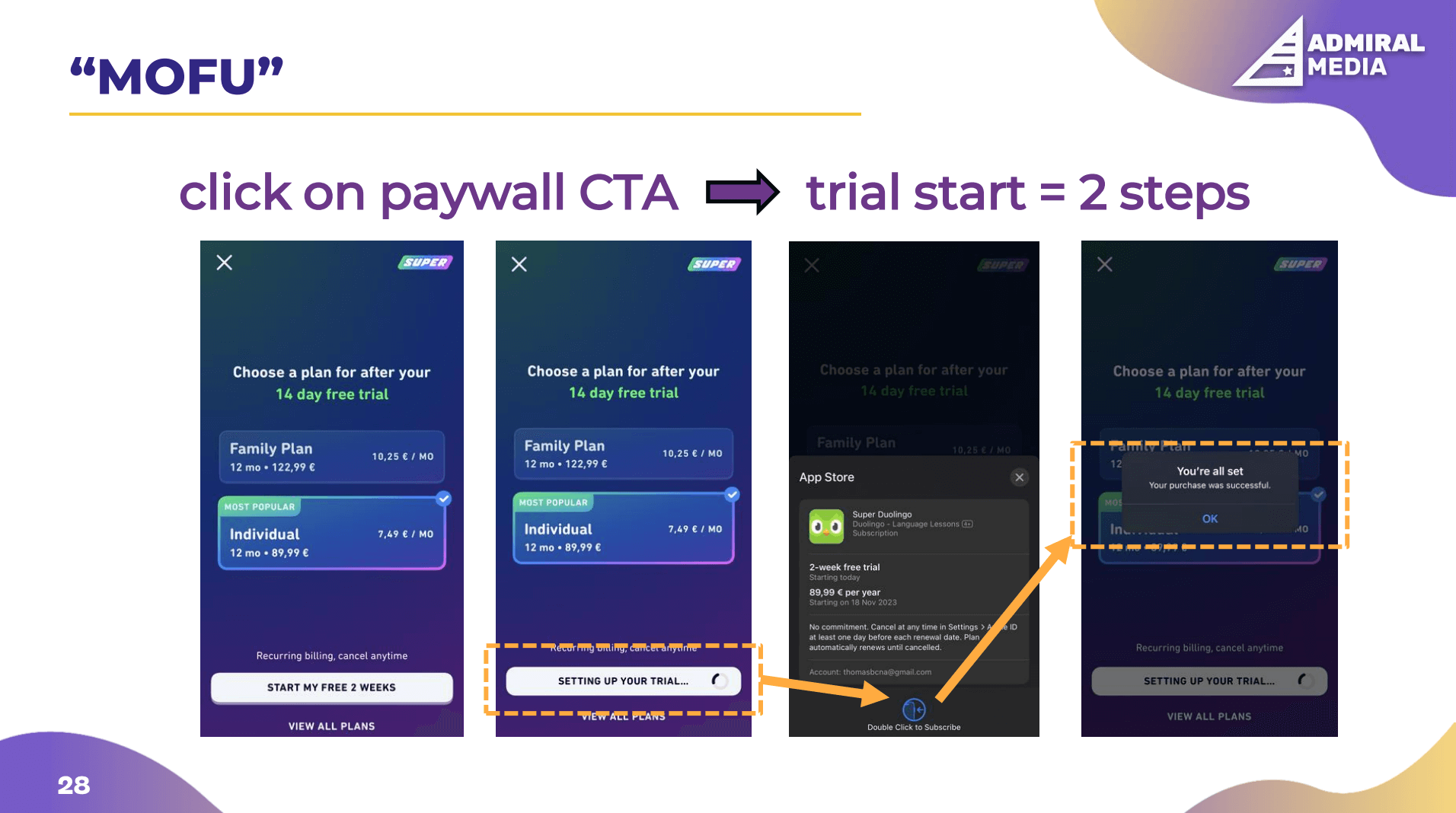
There are always more steps to a user subscribing than it looks like. Track each step in the funnel (e.g., track open checkout separately from start trial).
Growth is bigger than UA. Product is more intertwined with marketing; you have to compensate for higher acquisition prices with better onboarding and monetization.
One approach for web campaigns is to remove all possible friction and focus on raising users’ intent before they get to the app store page, instead of trying to get them to sign up or pay directly on the web. It is challenging because the onboarding might need to be completely different depending on the app.
Changing the whole onboarding/freemium experience is going to have more impact than incrementally testing price. Example: paywall on the first screen or how much you offer for free instead of testing $50/year vs. $70/year.
The real benefit of a web onboarding flow is that people become your direct customers. It is a massive benefit to have that direct relationship, as it brings flexibility when it comes to cancellations, refunds, renewals, etc.
Once people download an app you can get a great completion rate even with a longer in-app onboarding, but this might be more challenging to do on the web.
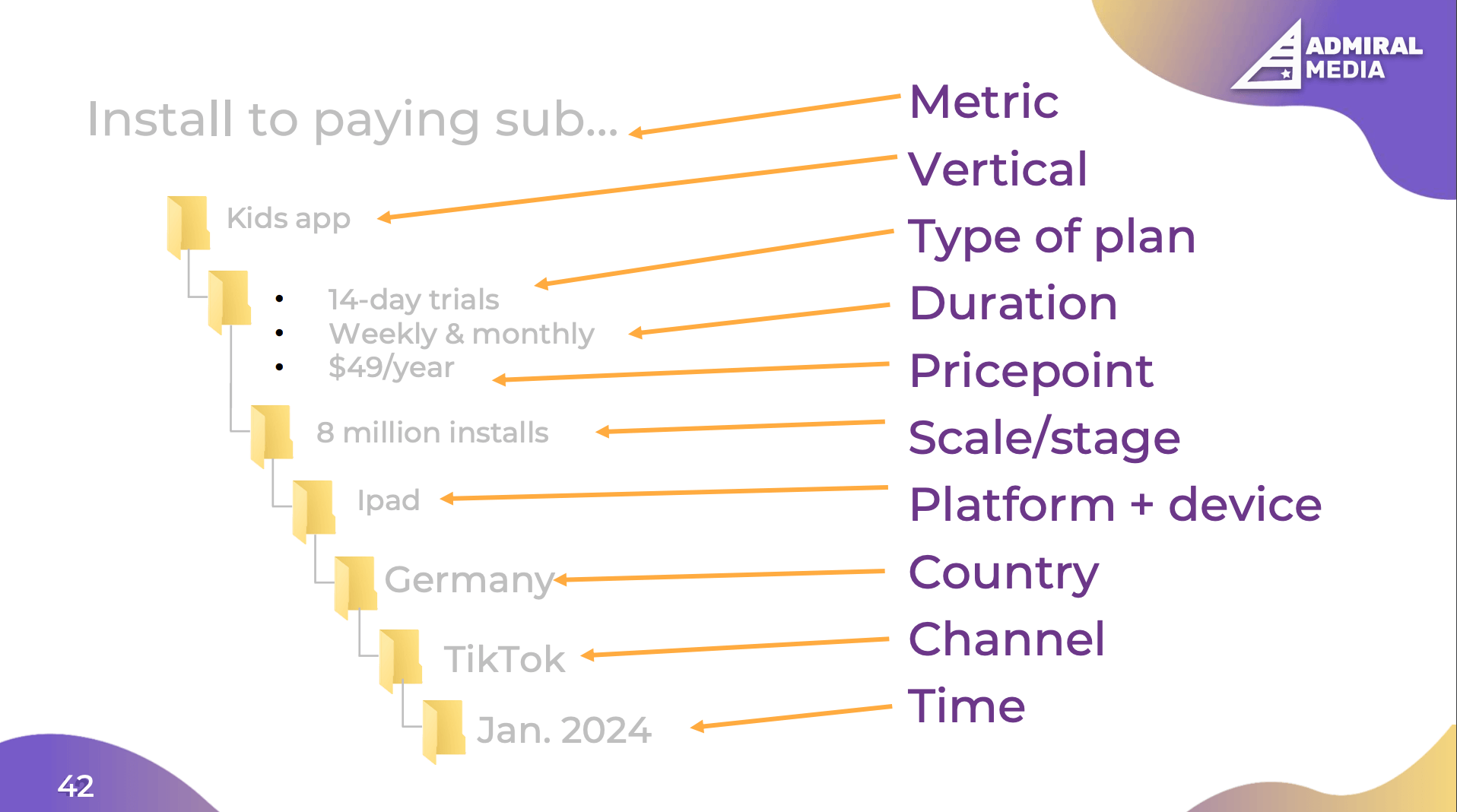
There are so many variables (segments, attributes, etc.) that comparing yourself to benchmarks is very hard. It’s much more important to improve what you had six months ago rather than measuring yourself to a benchmark. Just try to be better than yesterday.
Play the long game, and think holistically: don’t look at metrics in isolation. Think about the impact on your retention and the consequences on your brand when playing with monetization.
There is a natural tension between monetization and retention and between retention and organic acquisition. The more you monetize, the less you retain not only the paying users but also the free users. You need to decide where you put yourself on the spectrum of freemium strategies.
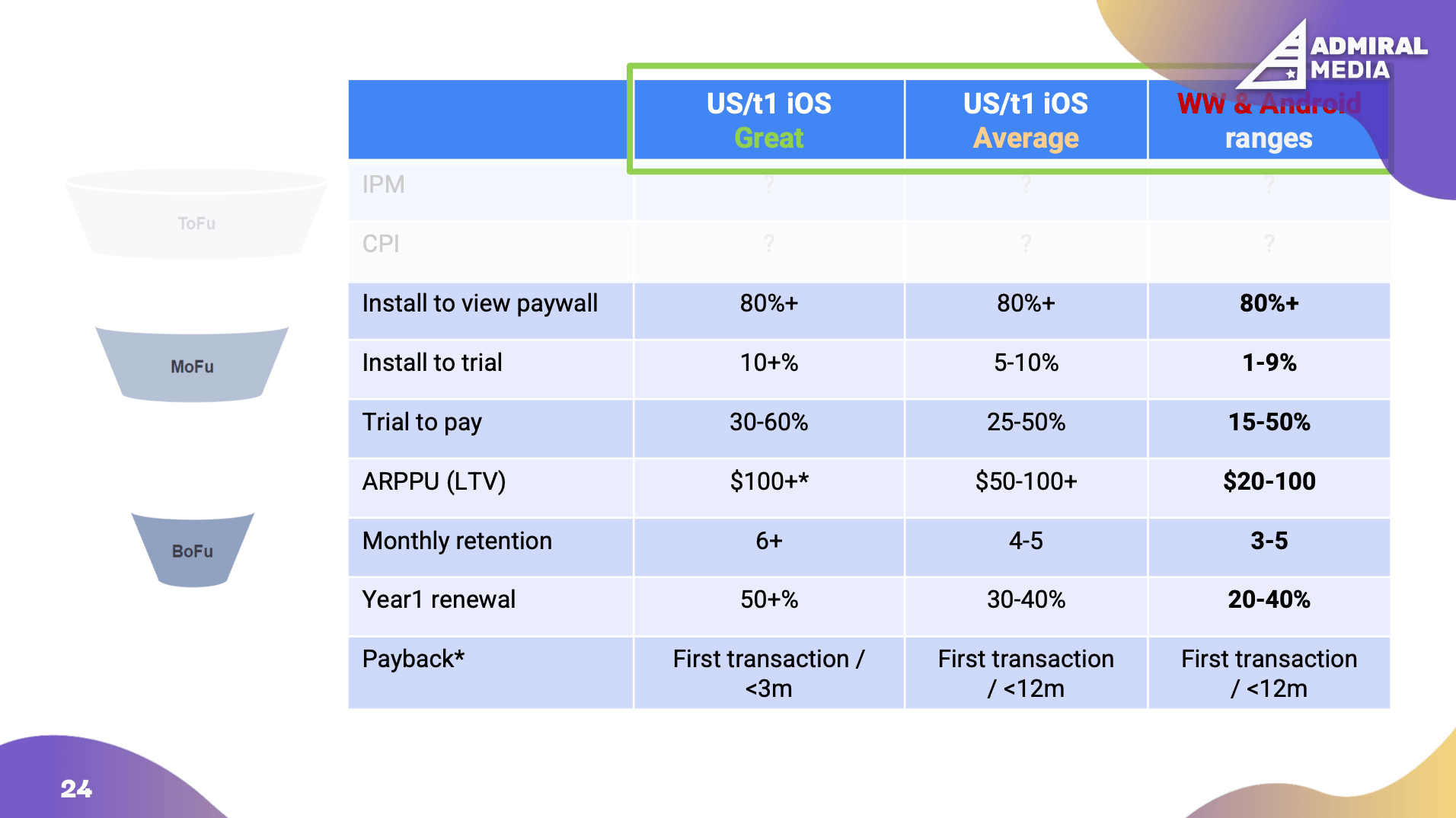
You can’t just look at the benchmarks' averages; you need to understand to which platform and geo they might apply. Example: US/t1 iOS vs. WW/Android ranges.
As a UA manager, you need to understand the product roadmap. Knowing that features that will increase DX ROAS are coming can allow you to take more risks. You also need to understand the company's cash flow and have a broader understanding of the business.
Later stage companies should probably have a bigger focus on the payback period (instead of LTV/CAC). The longer the payback period is, the more risks you take that things may change and the more you have chances of being wrong about assumptions. Anything more than 12 months shouldn’t be done.
The pre-ATT playbook was to have acquisition mainly driven by paid and to have aggressive monetization/paywalls. Now, more apps are questioning if there are other ways to do things(examples of apps “rebalancing” the model: AllTrails, Strava, Duolingo, etc.). Each app needs to find its own model.
⛏️ Going Deeper: Thomas also shared that you shouldn’t try to copy best practices from others, because the playbook is being rewritten and nobody really knows what works. Don’t assume anything, focus on what your customers want and test it for yourself.
Some inspiration can’t hurt however, and in Growth Gems #56 I included a few examples shared by Eric Crowley (Executive Director at GP Bullhound)👇
Once an AI tool is good enough for a repeatable niche task like voiceover, translating a winning creative into 12 languages, or scripting, stop chasing the cutting-edge model. A 5-10% quality gain is worthless when a proven, cheap process already satisfies the need; lock it in and reinvest the time elsewhere until you're forced to change.
"Oh, I've got this creative that works. I need it to have it in 12 languages now. I don't really care if it's 5% better left and right because they found something that kind of works. The process is there and the time gain into just applying this and at some point it might switch."
Producing more and faster is more important than producing cheaper. Cost savings is not the main driver behind using AI to produce creatives. People that were testing 5 ads are now testing 50, and people that were testing 50 are testing 2000.
One aspect that is undervalued is how AI can be used for creative analysis. Feed the AI top-of-funnel metrics (e.g., hook rate, hold rate, CTR, % video views, etc.). Some tools do that: Replay and AppsFlyer’s Creative Optimization. It’s about reading the data and looking into the creatives to identify what works.
I’ll add another one, which is more manual: Julius.ai (affiliate link - don’t judge me, just check it out).
Creatives
It’s complicated to understand why a creative is working, but it’s not complicated to understand when it’s working: the platforms are incredibly good at showing the creative that is going to work better (that’s when the creative is getting all the spend).
Advertisers work with content creators not just to reach their audience, but to tap into their ability to product content, because they know the rules of engagement on each platform, ie: they're good at making videos users want to watch
When starting with a new company, run data QA checks. Export a few common events (e.g. first opens, signups, important user activity, etc.) from the different data tools used, with a couple of breakdowns (e.g. over time, by platform), and make sure that the trends are similar _(i.e.,things move in the same direction and in the same proportions)_.
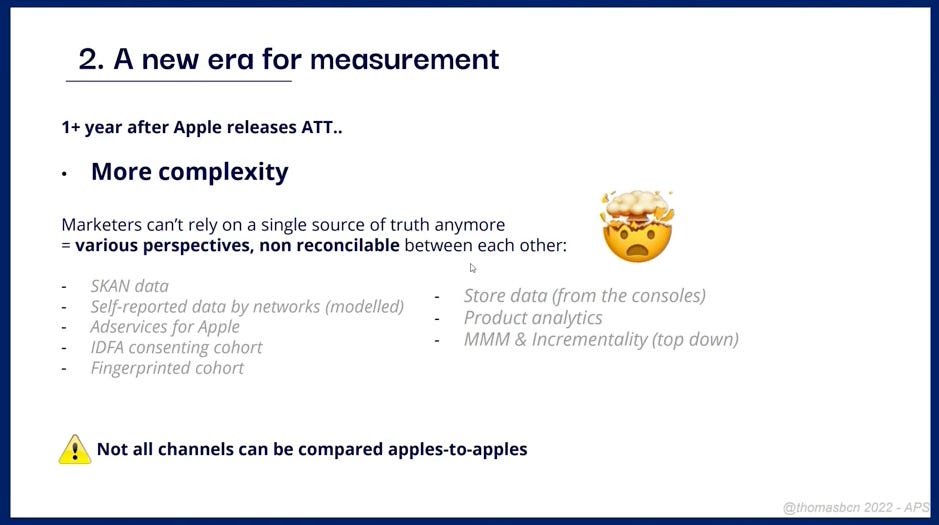
You need more data analytics work than ever. Instead of spending time on campaign management, look at the different data sources to make informed decisions. Never take networks' self-reported metrics for granted.
Pre-ATT, there were channels that were bringing a lot of “late converters''. Often, these late converters retained more, invited their friends more and in general had a higher value. These networks probably still bring the same conversions, but post-ATT, we have a blind spot when it comes to measuring these.
Media mix modeling and incrementality tools are a complement, and only advanced teams can afford to have this complement. If you’re operating at a low level of spend, don’t get into this rabbit hole for now.
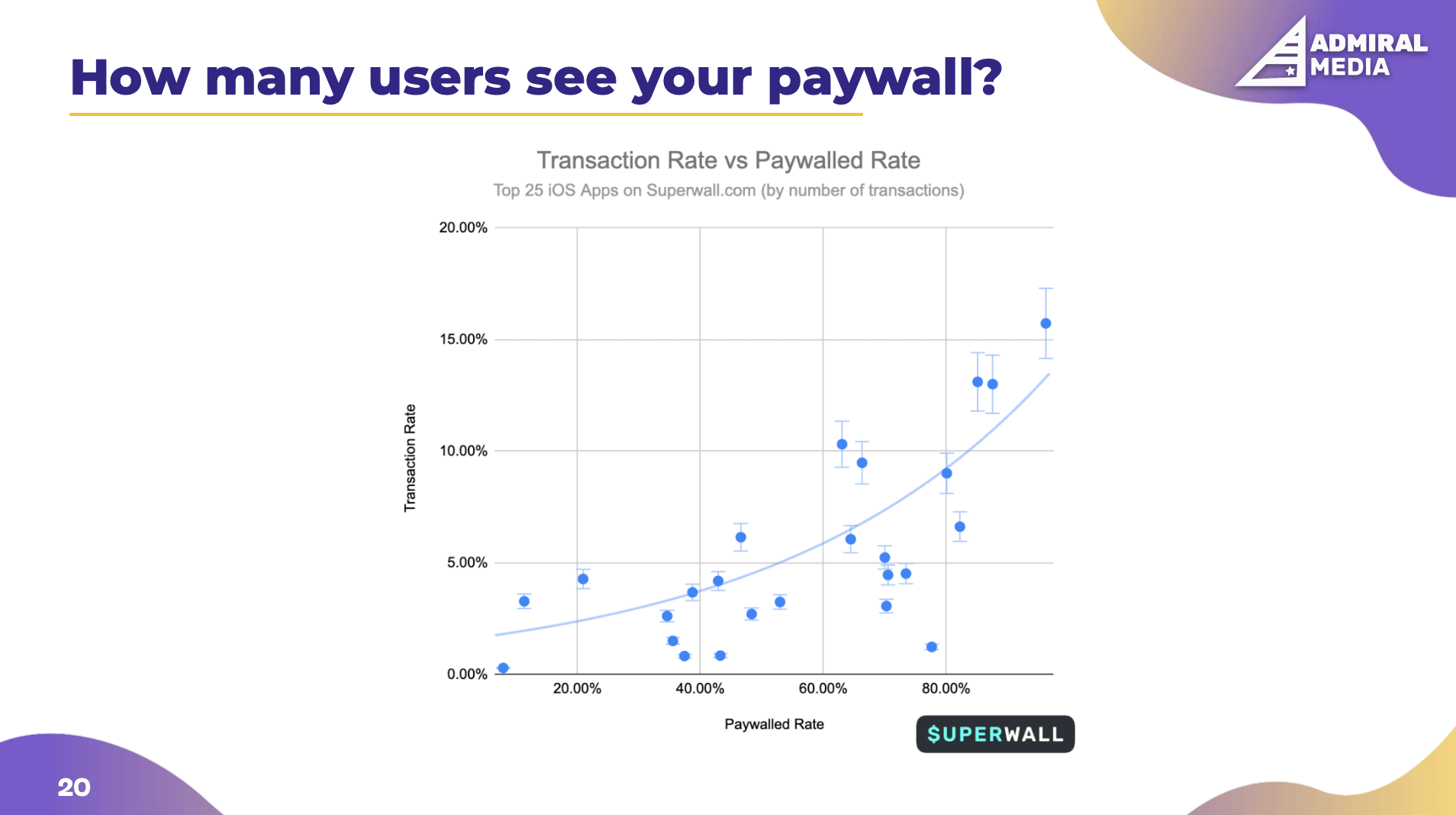
If most users don't see the paywall, they can’t access your trial. Aim to have 80%+ of users see the paywall. However, this doesn’t mean y’ doesn’t mean you should put your paywall on the first screen!
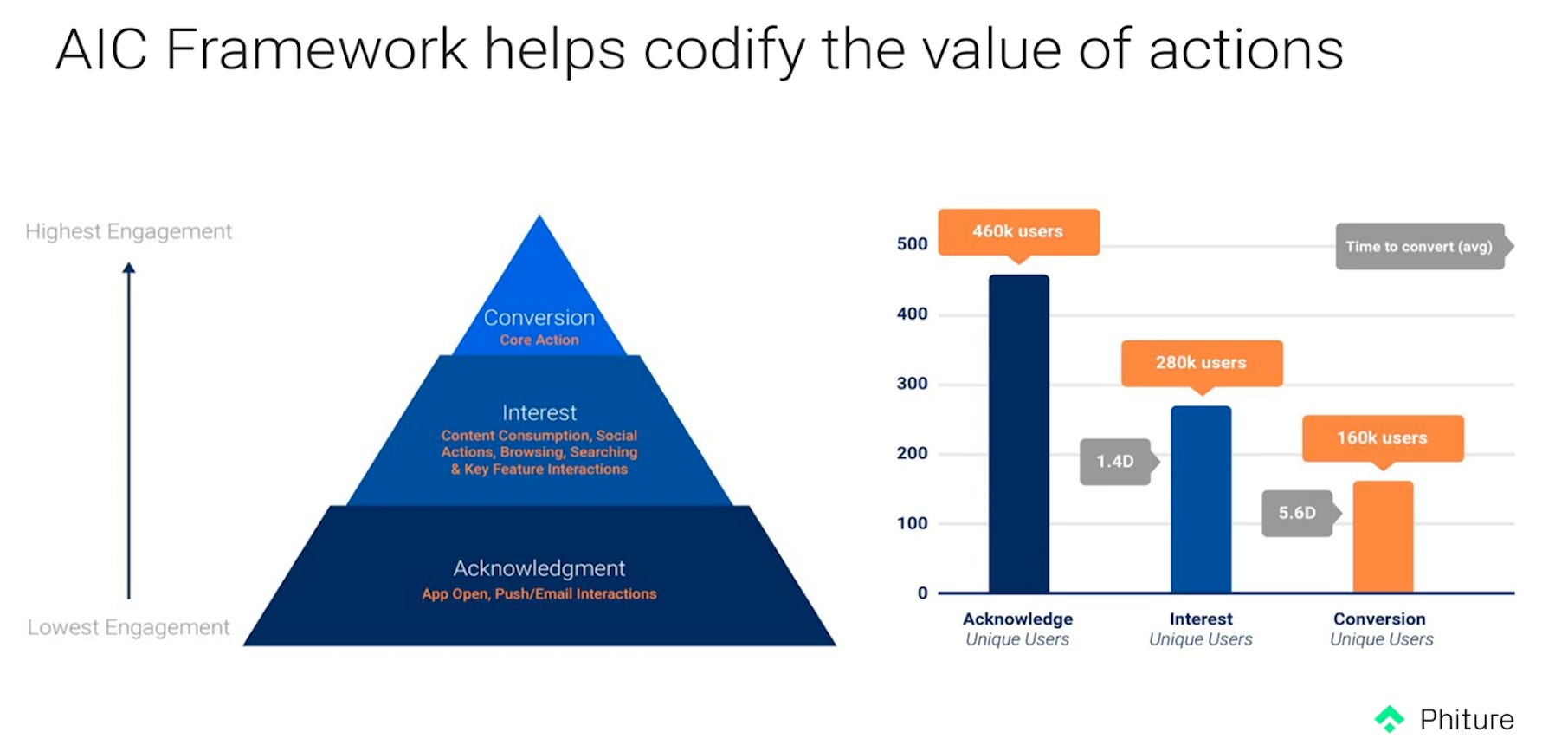
⛏️ Going Deeper:in Growth Gems #52 I shared a gem by Andy where he explained how Phiture uses the AIC framework to help with “signal testing” (identifying the signals of conversion and optimizing for them)
Monetization
Something to consider when introducing web payments: the whole funnel is going to be different.
Before payment: conversions (and therefore onboarding)
After payment: renewal rates, refund rates
It makes it hard to compare app vs. web payment. The comparison can also take a long time, during which a lot of mistakes can be made.
⛏️ Going Deeper: the panel shared that renewal rates on the web tend to be higher for several apps. It’s probably due to a combination of things: users don’t get a nudge onrenewals like they do with Apple, you’re sending your highest intent users to the web flow (e.g. email opt-ins for promos), the initial friction of putting in the credit card filters out the lower-intent users. This is why you need to take the whole funnel into account (cf. LTV/CAC ratio in Growth Gems #50).
Organic Acquisition
Organic Acquisition
ASO has limited scalability as a primary growth driver. While store optimization remains important for conversion, it cannot systematically drive large-scale growth. Focus ASO efforts on conversion optimization rather than expecting it to be a major acquisition channel.
"I've stopped selling ASO services in 2017. That was eight years ago. Like, and the reason I stopped is because I couldn't see that the value, the impact that I'm bringing can compensate for the money that I ask in a reliable way. Basically, I was unable to produce systematic impact at scale."
All successful large-scale apps rely on paid acquisition or other non-ASO growth methods. ASO should be viewed as a necessary conversion optimization tool rather than a primary growth strategy, with clear scaling limitations.
Work on virality and referrals, but be careful that the apps that have gone the most viral have often vanished. When you grow a lot based on instant virality, you’re usually tapping into pretty peculiar needs in the Maslov Hierarchy, but it often goes down as fast as it goes up. Examples: ClubHouse, TBH, Gas, etc.
There is a cohort of users who will renew regardless of their usage retention, so split retention in two: Always specify if you’re talking about payment retention (renewal) or usage retention (actually using the app).
Benchmarks for renewals have the highest variance because rates vary depending on what you’re selling: monthly vs. yearly, low price vs. high price, etc. But if you have around 40% renewals like Duolingo, it’s decent, and you might want to focus your efforts elsewhere.
Don’t sacrifice your brand for performance. Always keep your brand foundation in mind. Understand what drives a user to your app, but don’t tarnish your brand name to drive a cheap user or someone who doesn’t retain. Have some pride in what you’re trying to promote.
CRM & Lifecycle tactics are more important than ever. This allows you to focus beyond the very early part of the journey and mitigate the loss in remarketing.
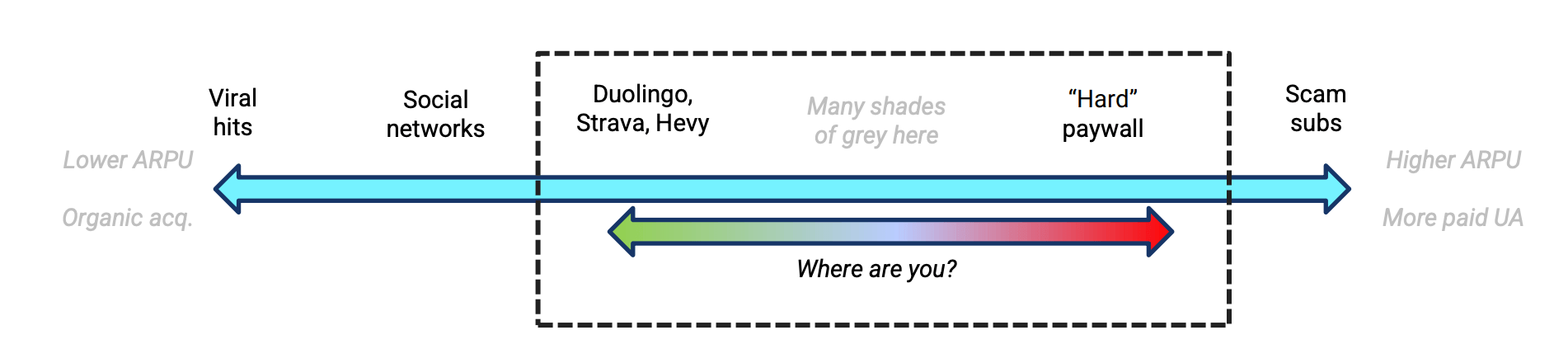
Having multiple paywalls during onboarding is a great way to increase the install -> paywall view metric, and often conversions. However, one important consideration is how important the free cohort is for you because multiple paywalls moves your place on the freemium <> premium spectrum.
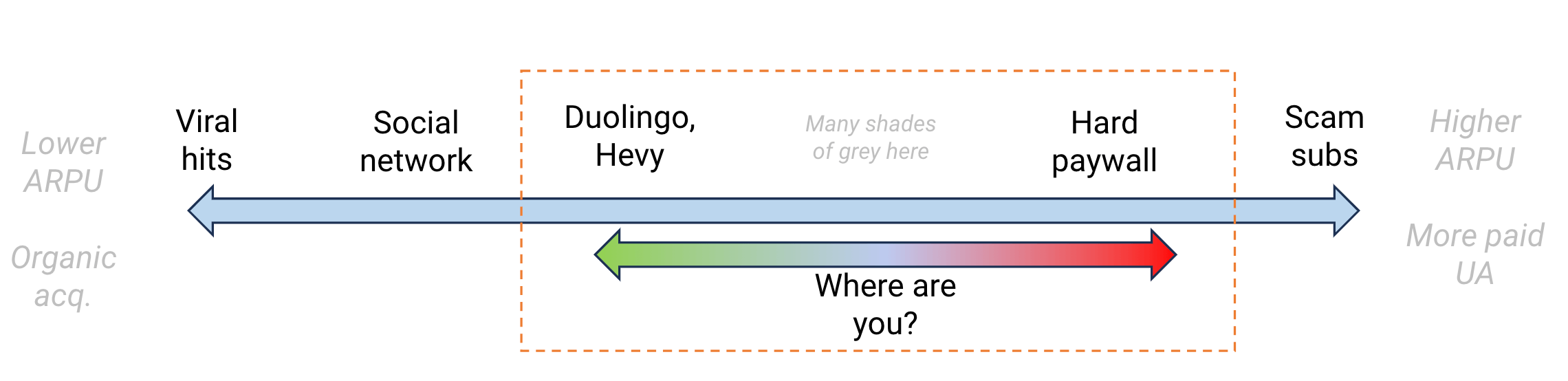
This is a strategic decision. Here is the “spectrum” that Thomas shared a few times before”.
Where are you? And where do you want to be?
This is also not a decision set in stone: it might very well be justified to start with a hard paywall when looking for product market fit and initial traction, then move towards freemium. Kenneth Schlenker (CEO at Opal) actually recommended thisin his insights from Growth Gems #108.
It’s a huge asset to have a strong community outside of the app that talks together, etc. but it can make things challenging when it comes to monetization. One way to solve for that, and leverage this community, is to ask for donations. Donating becomes a “badge of honor”: users become ambassadors and benefit from social influence.
It got me curious, though: what if donations was what you use as a back-up offer? Is anybody doing that? I’ve seen it done with “pay what you want” offers (a few price point choices), but never with donations.
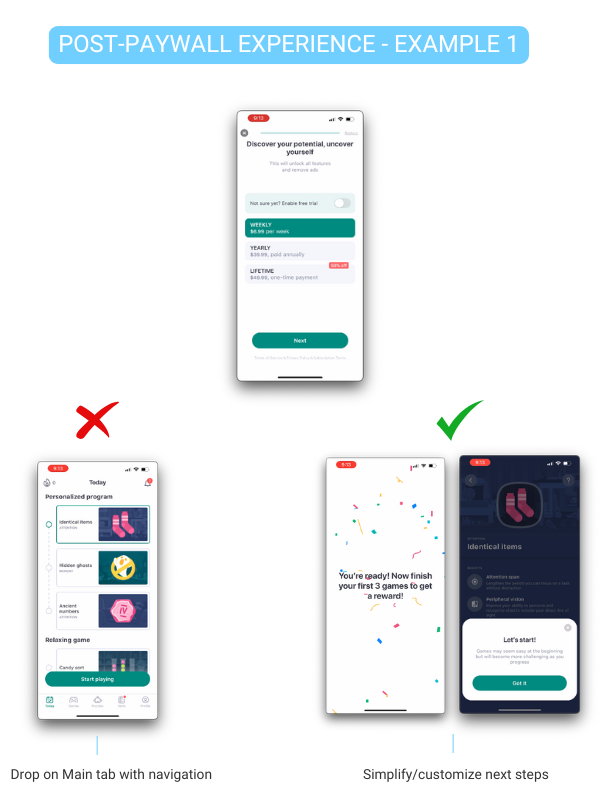
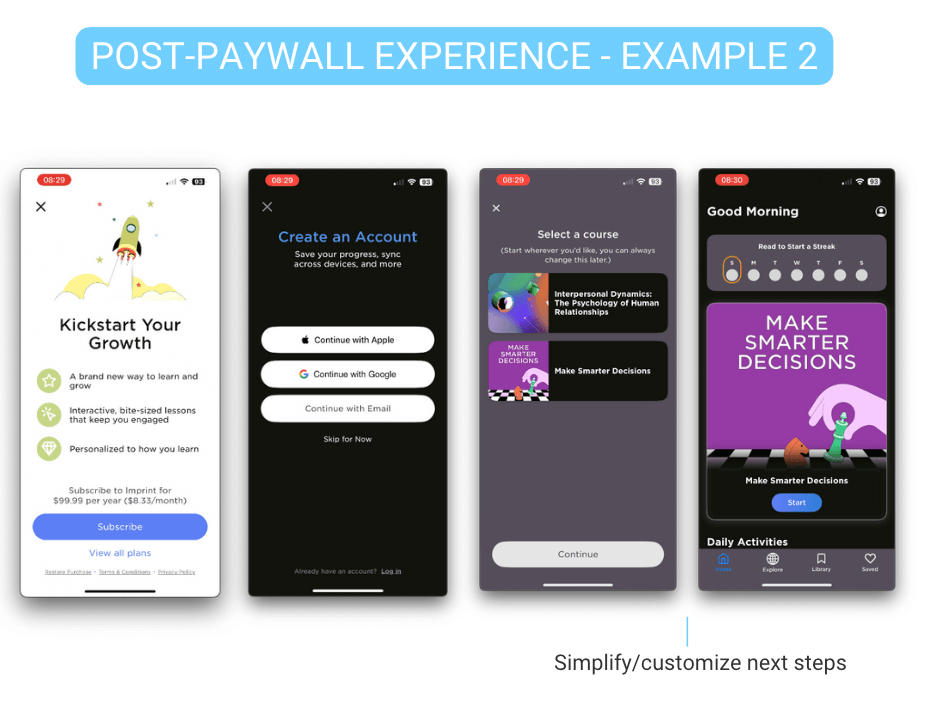
Simplify the app post-onboarding to drive users to the most important action you want them to do. You can delay showing features until some progress has been made.
This is something that Faye Keegan (CEO of Dipsea, acquired by RevenueCat) mentioned in the Sub Club podcast episode Pioneering a New Genre of Audio App: If you limit the possible “happy” paths in the free experience to the ones you think have the highest value, you’re probably going to do the best.
Elena Verna recently wrote Should your new feature be free or paid? and one of the arguments for putting something in the freemium tier was that if the free version of your product doesn't receive updates or new features, it can become stale and less appealing. Another good point she made is that “freemium defines your product’s brand”.
“Aggressiveness of monetization” comes in many different shades, and those “tricks” often works: toggles, wheel of fortune on or after the paywall, backup offers, fake loading screens, etc. But you need to find the balance so you don’t give an overall scammy feeling.
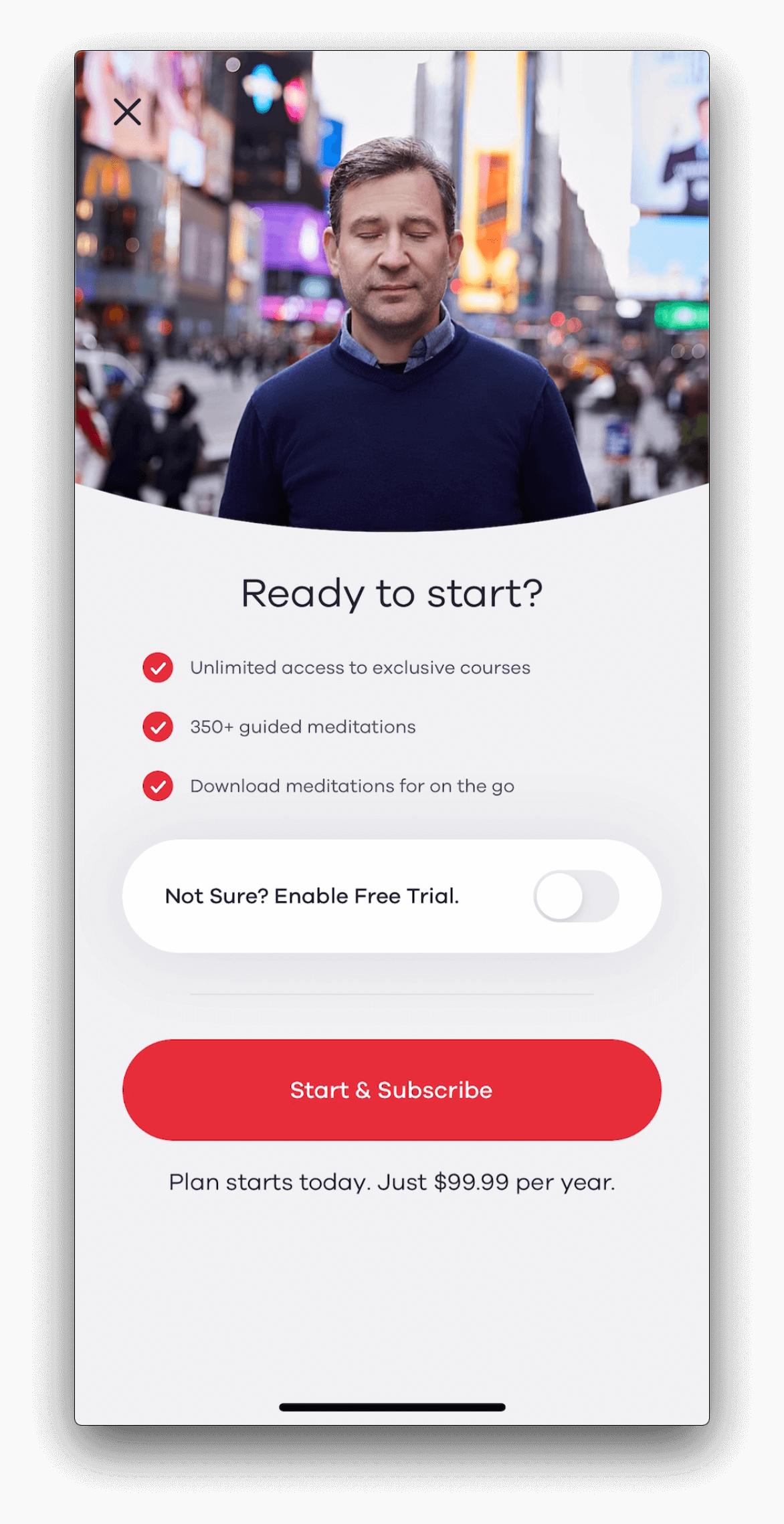
You’ve probably seen the “free trial toggle” before, but if not, here is one example:
And what is the wheel of fortune, you may ask? Below is an example courtesy of Victoria.
It doesn’t have to be a wheel. Here are other examples (first one courtesy of Murat).
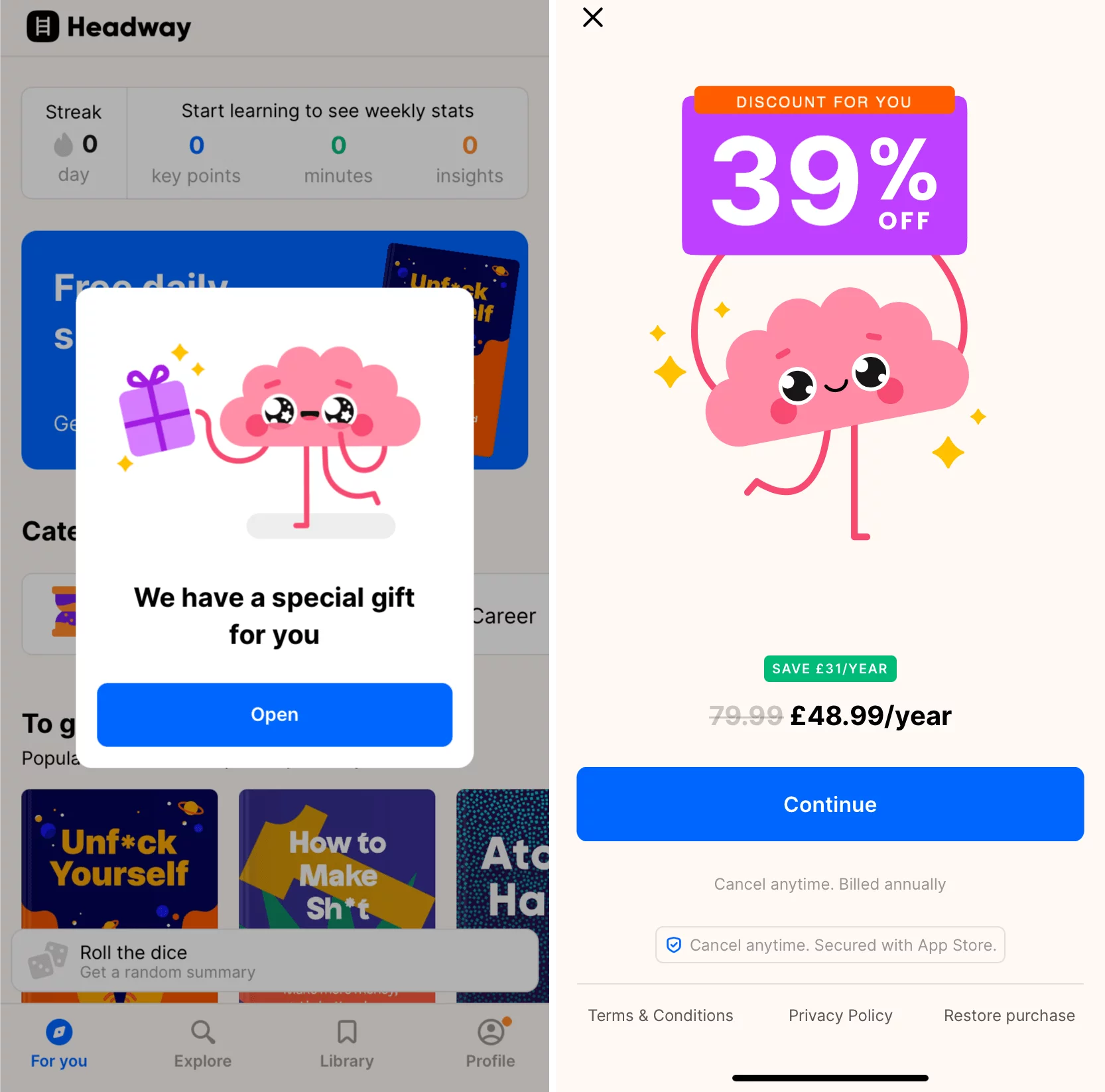
Finally, Headway is famous for its back-up offers:
Separately, those tactics might just bring you great wins…But combine too many of them and you might give a certain feeling to users. An example of that is the Me+ onboarding: this goes past MY personal threshold and would prevent me from converting or at least categorize the app as sneaky/cheap (typos don’t help).
If you see users that retain better because they do a specific activation activity, don’t conclude that it means you should force all users to that path: they may retain better because they search for or found the activity, and driving more people there might not lead to overall retention improvements
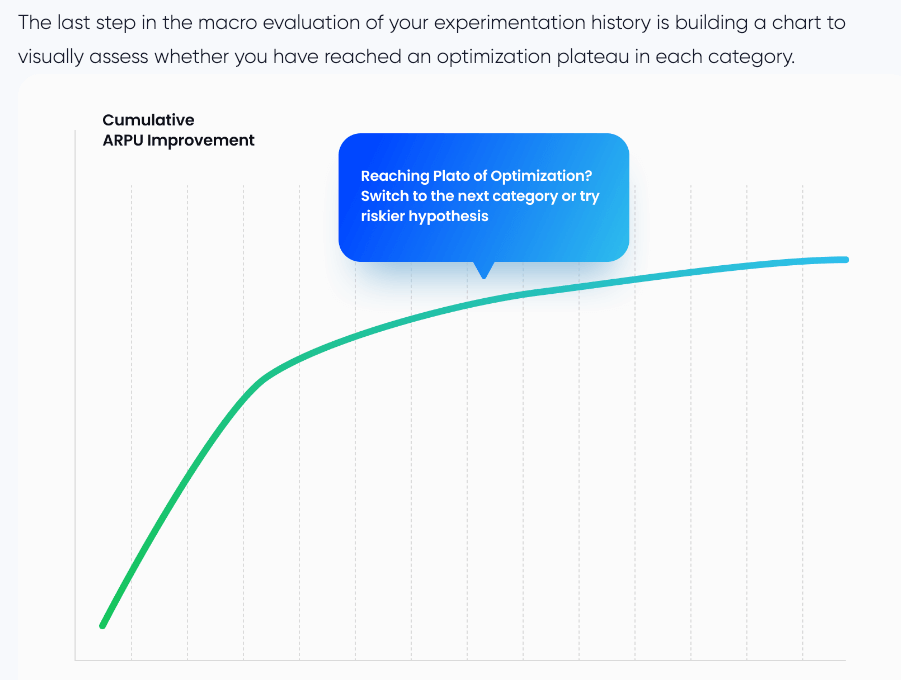
When you start seeing diminishing returns (lower success rate, smaller wins) on a type of tests (e.g., paywall, parts of the onboarding, etc.), it is a signal that it's time to explore other areas to test.
Communications between the monetization and UA teams should go both ways to pick the right moments to test. You can also compromise based on the test “risk profile”: timing, geos involved, % of users on which an experiment is tested, etc. Examples: Don’t launch an impactful monetization experiment right when the UA team opens up a new channel (or vice versa).
You don’t need someone to sign up via email before you get them to purchase. It makes things more complicated, but it might be worth it in some cases. For example, you can show a paywall very early on (e.g., pre or mid-onboarding).
If you need to split users during onboarding to provide a different experience (e.g., team use case, professional use case), one way besides asking a direction question is to figure out some specific activity they need to do to progress on that branch (e.g., add colleagues). Just be careful of the added friction that you’re introducing.
Monetization tests or changes can drastically impact UA. Potential gain in monetization can have a long-term impact, justifying the disruption of acquisition stability in the short term. Example: adding/removing a free trial toggle, switching to purchases, etc.