Growth expert leaderboard · Expert

Alper Taner

· LinkedIn

28 insights on Paid UA, Creatives and Data from 3 talks and podcasts, each with the quote and a link to the moment it was said.

Is this you? Suggest an edit

Creatives

Creatives

Determine your creative testing spend threshold by analyzing when cumulative spend and CPX metrics stabilize. This prevents both overspending on bad creatives (wasting 10K+ when $500 would suffice) and underspending on potentially good ones. Find your account-specific decision point.

"Look at your cumulative spend and cumulative CPX metrics, whether you're testing on a CPI or cost per trial or just cost per subscription and such, and see when they stabilize. So, because I see a lot of accounts with high spend, they're sometimes just spending 10K, 20K only to realize, oh, this is actually not a good creative. I'm like, oh, really? I could tell it after 500 bucks."

Challenging Best Practices in Mobile Growth – Alper Taner’s Secrets to Success at 17:08 · Featured in Growth Gems #142

Sylvain's take:

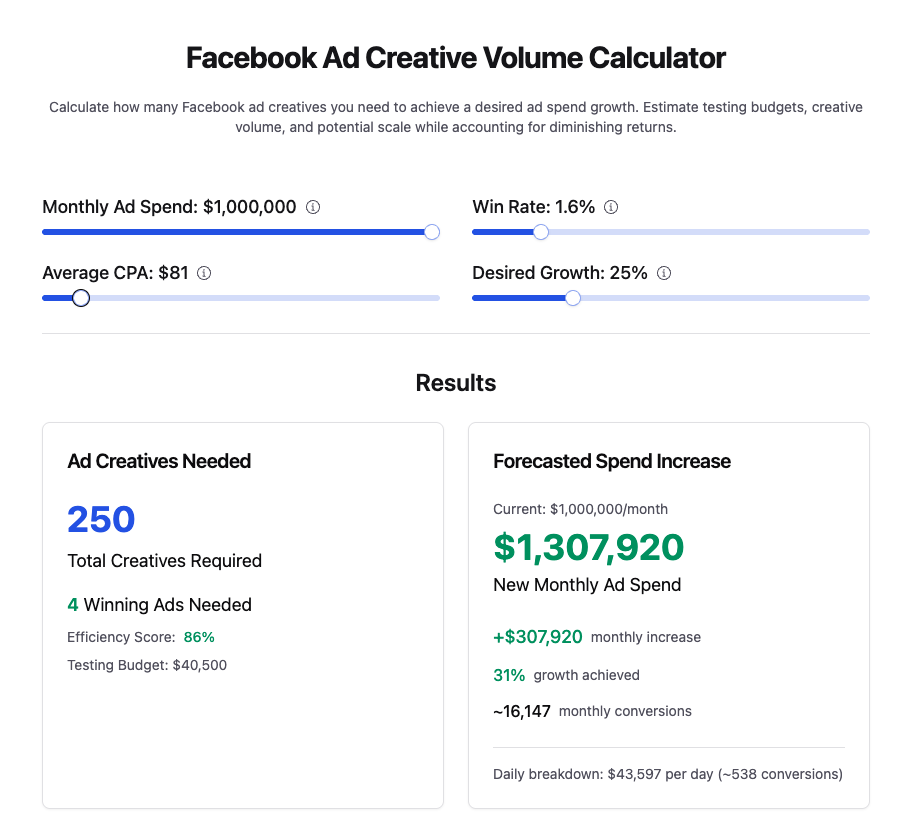
As you think about this, you might want to play around with NewForm’s Creative Production Calculator (corresponding post here) and AdManage’s Ad Creative Calculator.

AdManage’s creative calculator

Creatives

The real KPI of a creative testing system is cost per successful creative, not the number of creatives tested.

Challenging Best Practices in Mobile Growth – Alper Taner’s Secrets to Success at 14:16 · Featured in Growth Gems #142

Sylvain's take:

That's an interesting thought, but I don't think that's true in all instances: for example if you're spending 1 million per month, whether it costs you $1k, $10k or $20k to produce and find a winning creative doesn't matter that much.

Alper’s counterpoint:

“if your Cost per successful is going up over time, something is likely wrong with the setup. I think it matters, its always about efficiency. Absolute number might not matter, decreasing over time matters.”

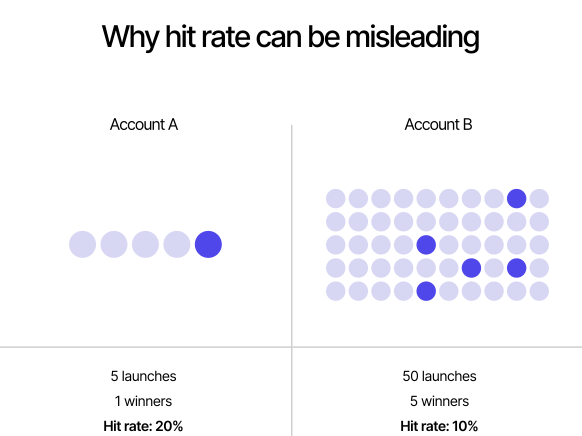
While we’re on the topic of creative hit rate, I also recommend the brand-new Motion’s Creative Benchmarks report (D2C focused but a great read!).

Source: Motion’s Creative Benchmarks report

Creatives

Use Meta Ad Library strategically: if a competitor has 15+ variations of one concept versus 2-3 of others, it's likely a winner they're iterating on. But treat this as inspiration only because their success doesn't guarantee yours due to different audiences, funnels, and positioning.

"You can check the meta library to see how long competitors are running a particular ad and how many variations of that. If there is one concept with 15 variations and that is the only one that has 15 variations compared to other ones having just two and three, you should be able to interpret that that creative is likely performing well for them. That's why they're exploring more angles."

Challenging Best Practices in Mobile Growth – Alper Taner’s Secrets to Success at 28:02 · Featured in Growth Gems #142

Sylvain's take:

If you look up competitor ads by Facebook page, I’ll also let you in on a little secret: you’re not seeing all their ads…

Creatives

When a company is testing a high volume of creatives, the level of detail and quality to shape the next input is sometimes jeopardized.

Challenging Best Practices in Mobile Growth – Alper Taner’s Secrets to Success at 16:17 · Featured in Growth Gems #142

Sylvain's take:

Very good point. With the increased creative production volume (because you’re scaling and because of AI), it’s easy to just categorize based on down funnel performance and fall into the trap of testing and throwing away anything that doesn’t work.

Creatives

In creative testing, quality of learning beats quantity of test. Creative strategy is about forming hypotheses and learning what works or not, and why. You still need to test a concept with a few variations!

Challenging Best Practices in Mobile Growth – Alper Taner’s Secrets to Success at 12:21 · Featured in Growth Gems #142

Sylvain's take:

You still need to test a concept with a few variations! He’s seen the 3rd variation of a concept win after the first 2 variations had failed.

But his overall advice there is to optimize for faster learning per creative tested rather than creative volume.

Creatives

Merge multiple data sources for creative hypotheses: Meta performance data, in-app analytics showing what high-LTV users engage with most, competitor concepts, trending formats, and category-level inspiration. Don't rely solely on ad platform data: your best creative ideas may come from understanding what retains users.

"When it comes to what creative to test, I think you should utilize both the first-party data and the third-party data. First-party data meaning like your Meta creative output. That's one variable that then that's a valid input. But you also have, let's say, for particular copy like, or let's say if you're testing particular visuals and such that also exists in your app, right? Okay, what is the most popular thing in the app that is more valuable for the users."

Challenging Best Practices in Mobile Growth – Alper Taner’s Secrets to Success at 26:00 · Featured in Growth Gems #142

Creatives

You must ensure you have a wide variety of creative concepts, from animation to UGC, with different approaches to the problem or solution you’re focusing on. These days, what typically works is broad targeting with creatives aiming at the right personas.

How to Efficiently Scale Ad Spend Beyond 7 Digits at 21:55 · Featured in Growth Gems #84

Creatives

To improve your creative strategy, reverse-engineer the creative’s brief based on performance. Find the similarities amongst the winners and similarities amongst the losers. Slice and dice the opening, the thumbnail, the main character, the USP, the CTA, the duration, the format, etc.

How to Efficiently Scale Ad Spend Beyond 7 Digits at 27:00 · Featured in Growth Gems #84

Creatives

Look into the IPM of your creatives and how efficiency changes over time, including on shorter time frames (e.g., last 7 days instead of just the last 30 days). Don’t let your creatives die; be ready to replace them with your next best creatives.

How to Efficiently Scale Ad Spend Beyond 7 Digits at 22:28 · Featured in Growth Gems #84

Creatives

The learning phase is very important, for all platforms. Don’t upload a new creative into the ad set every week. This will lead to fluctuations. Instead, make changes every two weeks and bulk upload the test winners.

How to Efficiently Scale Ad Spend Beyond 7 Digits at 16:20 · Featured in Growth Gems #84

Data

Data

Match your measurement tool to your question: use MMP for creative comparison, but use incrementality testing (geo-lift, holdouts) for channel comparison. Example: Google UAC's search intent makes it appear cheaper in last-click attribution, but that doesn't reflect true incrementality.

"There is not one single source of truth for every answer you're looking for. So if you want to compare creatives against each other, like, MMP could be your best friend. But if you want to compare the impact of UAC versus Meta, MMP is likely not your best friend because one is a push channel, one is a pull channel."

Challenging Best Practices in Mobile Growth – Alper Taner’s Secrets to Success at 34:00 · Featured in Growth Gems #142

Sylvain's take:

It comes down to looking at multiple sources of data. Even for creative comparison, you need an understanding of the down-funnel performance.

Data

Take the time to test your hypotheses properly (with adequate spend, duration, and variations) because premature conclusions waste more resources than thorough testing.

"People like to come to conclusions fast, and I think because of the priorities, like because of this scarcity kind of a mindset, like they want to reach conclusions really fast and they want to move on to the next. So when they are in this kind of a mindset, I think then they're missing out on testing things properly."

Challenging Best Practices in Mobile Growth – Alper Taner’s Secrets to Success at 7:57 · Featured in Growth Gems #142

Sylvain's take:

This reminded of a few different gems around the “Minimum Viable Test” I shared in the past. Check out the corresponding LinkedIn post below.

Data

Don't label metrics as 'problematic' until you've systematically tested and iterated on solutions to improve them. Focus on understanding 'why' before declaring something broken. _Example: a low conversion rate is just a fact until you've diagnosed the root cause, created an action plan, and measured results. _

"Something becomes a problem after you systematically test it, iterate on the results and try many different ways, from, let's say, radical to iterative and you're still stuck at the same level, then I think I can consider that as a potential problem. Instead, you should always see what you can do or understand the root cause. So, diagnose any factual problem that you consider as a problem and then come up with an action plan and then measure the results to see the impact."

Challenging Best Practices in Mobile Growth – Alper Taner’s Secrets to Success at 6:31 · Featured in Growth Gems #142

Sylvain's take:

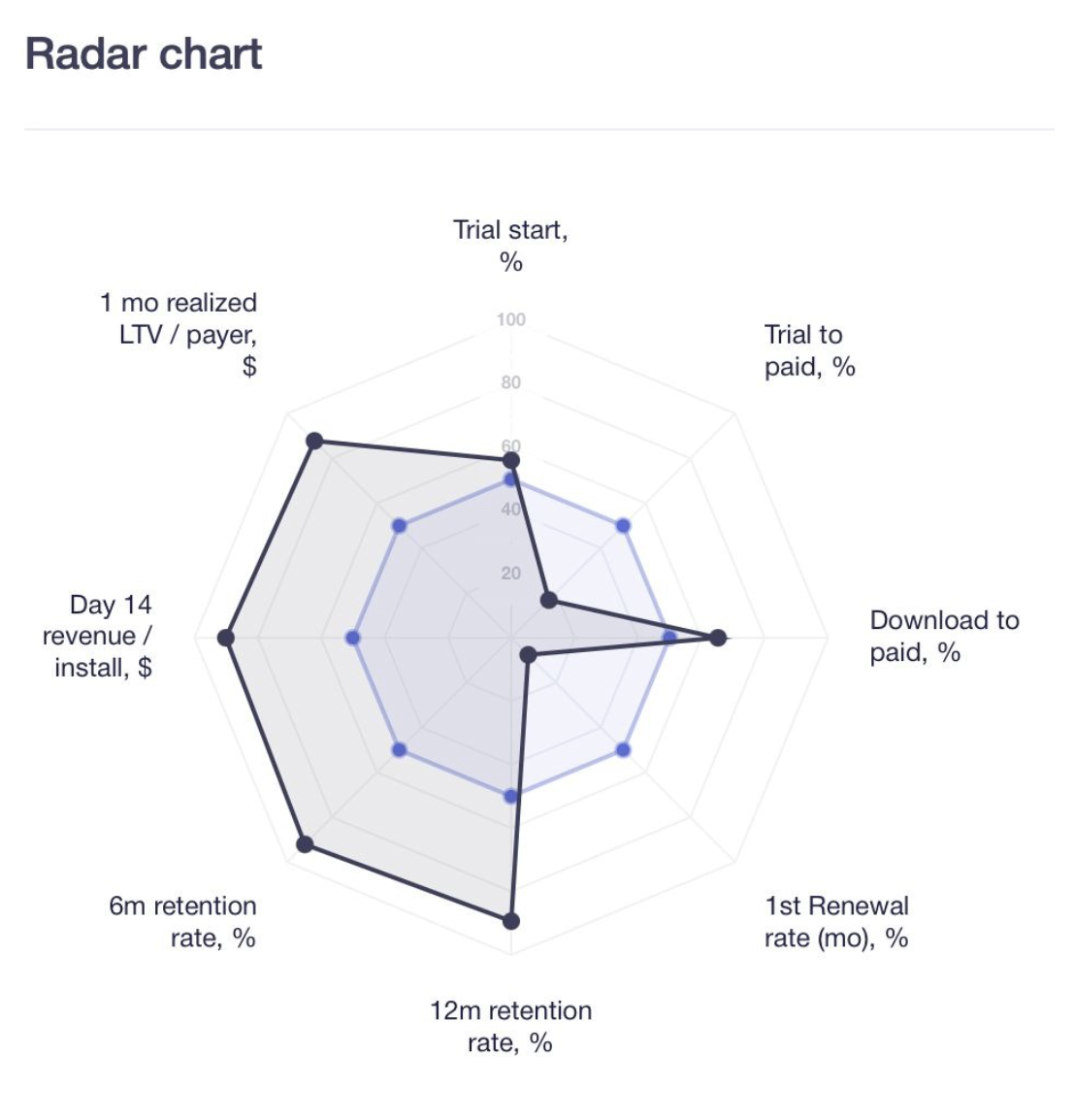
You can’t look at metrics in isolation. Even when you’re getting a health score with several metrics like what RevenueCat provides, it doesn’t tell the full story. Are you focusing on organic socials? Acquiring a particularly older audience on Meta? What’s your pricing? You need to understand the full funnel, and break down metrics by main segments.

RevenueCat’s Health Score Radar Chart

Strategy

Strategy

Always look at both short-term and long-term KPIs in decision making and budget allocation. Something that looks very good in the first place might be hurting the business in the long term. Example: giving too many vouchers, with users ordering only with vouchers.

Why invest in the right insights to succeed · Featured in Growth Gems #100

Strategy

The first step to understanding customers is to establish a robust tracking setup: right event, right event parameters, user properties that give you a comprehensive picture of users’ behavior. Then, analyze the latest actions and common behavior patterns of churners vs. those of high-LTV users. What are the key differences?

Why invest in the right insights to succeed · Featured in Growth Gems #100