Monetization
There is a spectrum of sophistication when it comes to international pricing.
- Less sophisticated (or not worth it): if getting the exact right price is worth a ton of effort, look at brands you admire in the space (e.g., Netflix, Spotify)
- To validate further, you can talk to users and run experiments
- You can also look at purchasing power parity and consider that to regionalize pricing per subscription
- The most sophisticated is to have economists build out demand curves to identify the revenue-maximizing and profit-maximizing prices. You need to be at a big sacle for this to even pay off. (Duolingo doesn’t do this)
Teams Involved in pricing x packaging decisions at Duolingo: product, finance, and data science. At Twitch: biz ops and economists. Leadership provides approval.
Pricing and packaging at Duolingo with Matt Long at 15:18 · Featured in Growth Gems #125
Sylvain's take: Jacob from retention.blog also shared his method for international pricing here, and mine is pretty similar: create a price index using a “basket of apps” (instead of copying Netflix).
Matt also mentioned the teams Involved in pricing x packaging decisions at Duolingo: Product, Finance, and Data science (i.e., not the Growth team - which focuses on engagement). At Twitch: Biz ops and Economists. In both cases, leadership provides approval.
Monetization
Small changes in the purchase flow like animating images the right way can have a pretty significant impact on conversions.
Pricing and packaging at Duolingo with Matt Long at 40:17 · Featured in Growth Gems #125
Monetization
Optimize the price you’re showing users based on what they’re familiar with:
- In the EU, that’s all-in price
- In the US, where taxes are added at checkout, it’s price before taxes added
Note: the growth team at Duo is focused on getting free learners into the app and keeping them engaged. They’re not working on pricing.
Pricing and packaging at Duolingo with Matt Long at 37:30 · Featured in Growth Gems #125
Sylvain's take: Said differently: in the US, customers are used to see a higher price at checkout (with added sales taxes).
Monetization
Some people are just against subscription, and having a one-time purchase product gets them into the purchase funnel: you now have their payment info, and it decreases the friction to upsell/cross-sell them to another product. Duolingo gets a "pretty sizeable" % of first-time payers via in-app purchases.
Pricing and packaging at Duolingo with Matt Long at 32:14 · Featured in Growth Gems #125
Monetization
When introducing a new tier, look at the percentage of users who choose the new tier versus the old tier. If you have a free trial, also look at the free trial conversion rate for the new plan versus the old plan.
Pricing and packaging at Duolingo with Matt Long at 8:54 · Featured in Growth Gems #125
Monetization
There is a tradeoff between how fast you move with a/b testing, how rigorous you can be, and how much risk (of backlash from users) you’re willing to accept. Think about how interconnected your customers are, how likely they are to talk to each other, and if they are talking to each other how likely this might turn into a problem. If people complain about seeing a higher price, have customer support can just take care of them.
Pricing and packaging at Duolingo with Matt Long at 41:55 · Featured in Growth Gems #125
Monetization
To figure out willingness to pay, you can do quantitative user research to do a willingness to pay assessment with surveys like MaxDiff, Conjoint Analysis, etc. This uncovers willingness to pay, but it is just an input because people may behave differently in real life, so you also need to run an actual experiment.
- Super Duolingo -> go faster with fewer interruptions
- Duolingo Max -> advanced learning that enables real-world practice. For people who are really serious about learning as quickly as possible and want speaking practice in a low-stress environment.
Pricing and packaging at Duolingo with Matt Long at 12:10 · Featured in Growth Gems #125
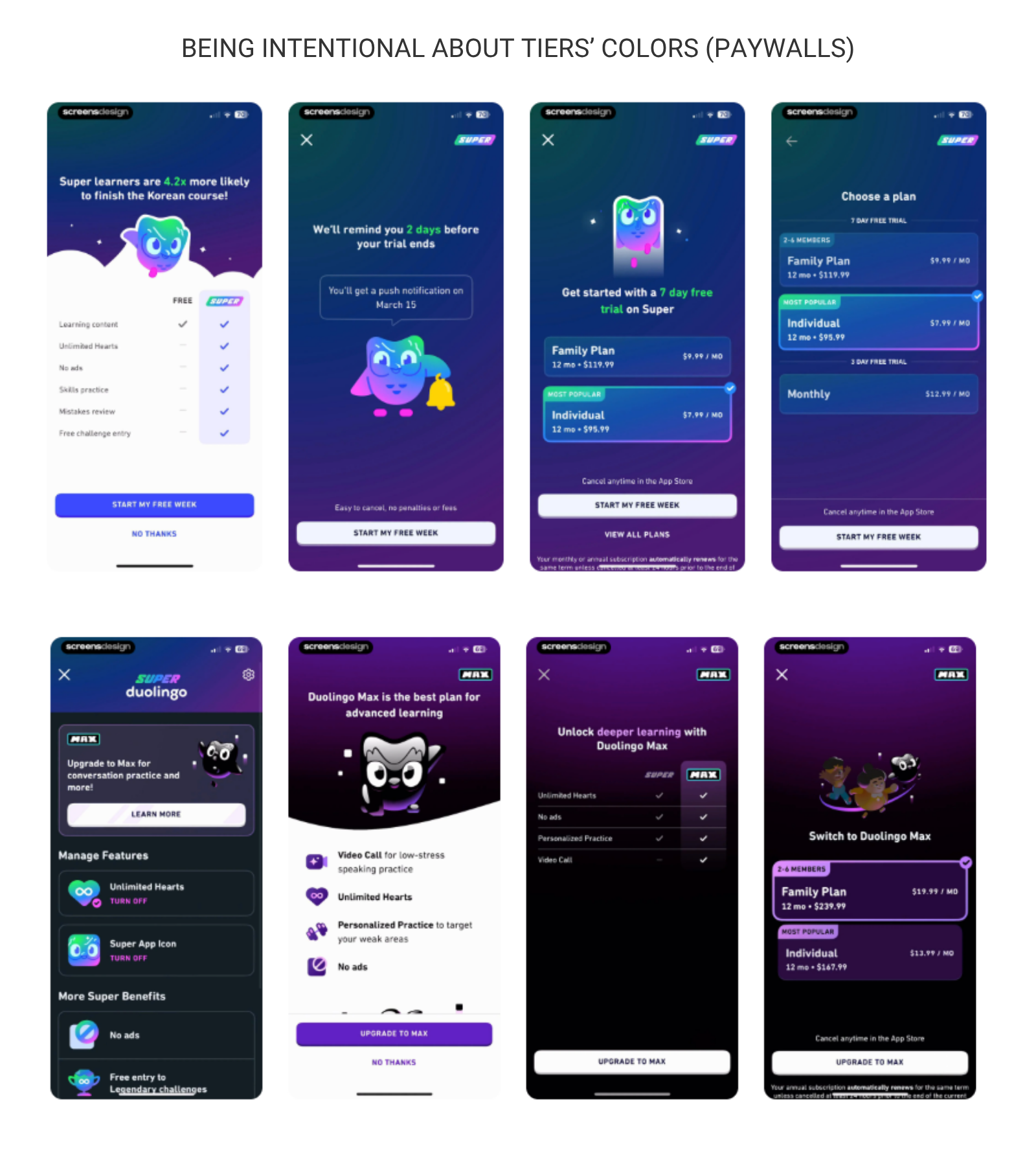
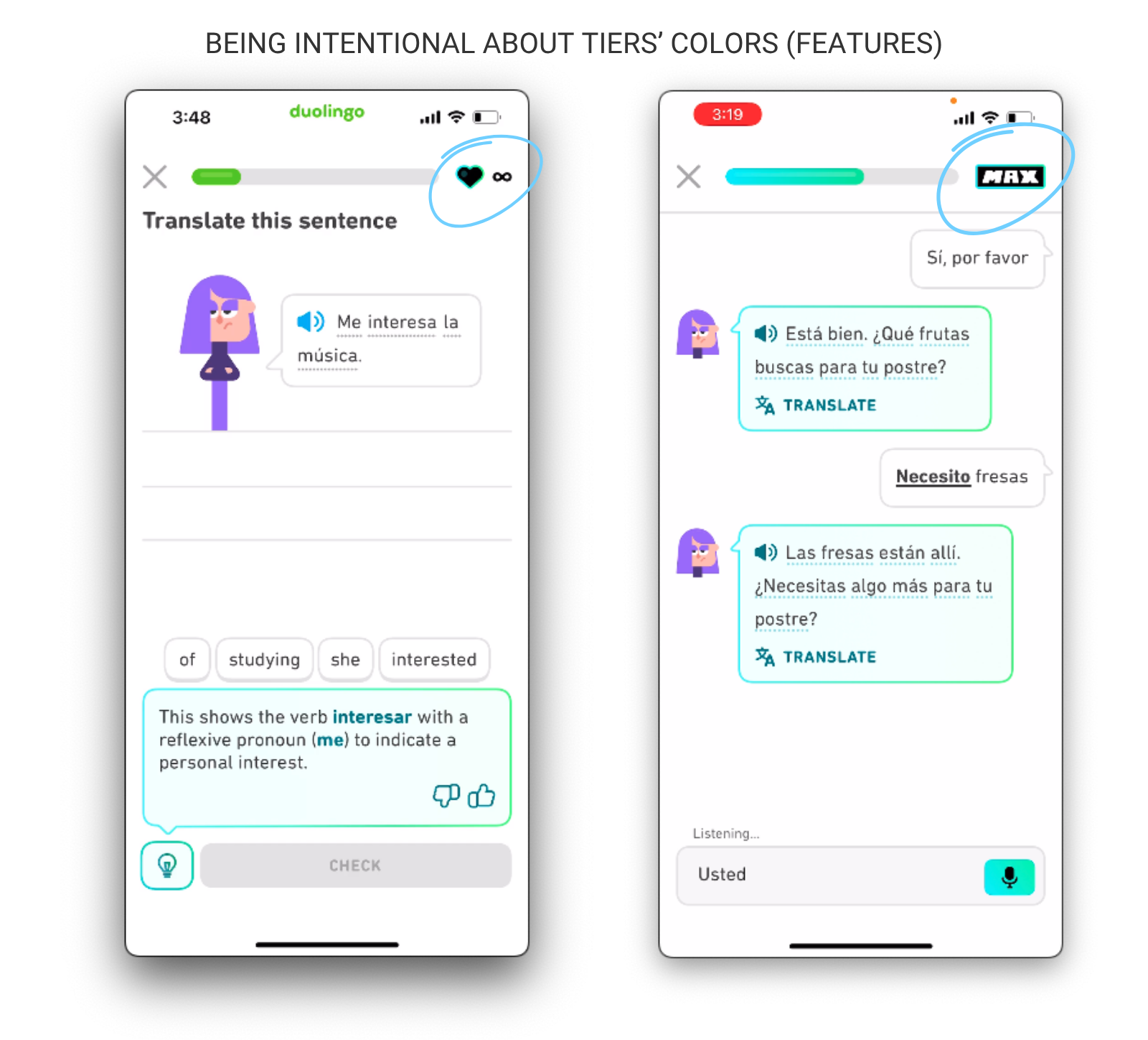
Sylvain's take: There are two things that I like about Duolingo’s implementation of a new tier:
They gather data and use it to upgrade to the higher tier (Max) based on it
They are very intentional with colors for each of their tier (see below for Max and here for Super), decreasing confusion and increasing upgrade potential
Monetization
If you want to maximize how much your existing users are paying, you have a few levers:
- Increase their retention and LTV by moving them from monthly to annual or from Individual to Family
- Introduce a higher-tier (e.g., Duolingo Max)
- Introduce an adjacent product
- Augment the subscription offering and its ceiling by having one-time purchases that are more natural to be purchased and used more than once a month. Example at Duolingo: gems, play some mini-games, dress up for the leaderboard, etc.
Pricing and packaging at Duolingo with Matt Long at 30:30 · Featured in Growth Gems #125
Sylvain's take: Be very mindful of the growth stage you’re in and your resources before you decide to get too sophisticated.
Monetization
Adding good friction to the purchase flow via more screens helps address user concerns systematically, like cancellations or trial forgetfulness. However, for users who have seen an in-house ad, it’s more effective to show a shorter flow.
Pricing and packaging at Duolingo with Matt Long at 23:20 · Featured in Growth Gems #125
Monetization
Subscription apps typically have a “hero” tier that most people will take and then a tier that’s interesting to a subset of users or a specific persona. For a higher tier, you want anywhere between 10-30% of revenue coming from the higher tier.
Pricing and packaging at Duolingo with Matt Long at 10:20 · Featured in Growth Gems #125
Sylvain's take: The 10-30% guidance might be different for apps relying on AI/LLMs since costs increase with usage.
For other types of apps, I would be extremely cautious about launching a new tier without clear signal that > 10% of your paying users could choose it. To figure this out, use the below before building:
Monetization
There are resources like Pageflows.com (mobile apps) or DowhatWorks.io (web) that can help you understand how products are presented and priced.
Pricing and packaging at Duolingo with Matt Long at 21:58 · Featured in Growth Gems #125
Sylvain's take: For mobile apps, my personal favorite has been screendesigns because of the search capabilities, video recordings and revenue filters. I also worked with the DoWhatWorks team and they were great!
Monetization
Leverage pre-selection. If you know what the user intent is based on where they came in to the purchase flow: make it easy on them to preselect what they want, and if they're agnostic then select what’s best for the business.
Pricing and packaging at Duolingo with Matt Long at 40:55 · Featured in Growth Gems #125
Monetization
If needed, to de-risk price changes, pick a representative/analogous country (e.g., Australia for Canada/US) to experiment on pricing. At Twitch - they needed a different approach, because users did talk to each other.
Pricing and packaging at Duolingo with Matt Long at 42:51 · Featured in Growth Gems #125