Growth Gems experts

Nicole Salzman Page

Zumba · LinkedIn

8 insights on Monetization, Product and Strategy from one talk or podcast, each with the quote and a link to the moment it was said.

Is this you? Suggest an edit

Monetization

Monetization

One of the optimizations that we've made to improve the conversion is defaulting to the payment method the user has available. So, if they have Apple Pay or Google Pay, we'll default to it first. And if they don't, they'll see the credit card option.

"One of the optimizations that we've made that we've seen, um, help us a little bit with the conversion is we default to what we see that the user has available. So, if they have Apple Pay, we'll default to that one selected first. If they have Google Pay, we'll default to that one first. And if they don't, then they'll just, uh, see the credit card option."

Optimizing Funnels, Pricing, and Retention at Zumba — Nicole Page & Lucy Levy, Zumba at 29:25 · Featured in Growth Gems #138
Monetization

When implementing app-to-web checkout, let users select their package (monthly or yearly) in the app first, then show only that view on the web checkout page. This stripped-down, familiar view that mirrors Apple's native purchase flow can significantly reduce friction and improve web conversion rates.

"We initially tested just letting people check out, um, click the app paywall, go to the web, and we compared that against just the in-app paywall. And then once Revenue Cat released the package selection, we developed it so that users could actually choose which one they wanted, monthly or annually, which package. And once they chose that, we would send them to the web, and we gave them the most stripped-down view on the web where we just showed them what they selected. We tried to replicate how Apple has that view, has that window on the app when you do an in-app purchase so that it looks very familiar, and that actually helped us with the conversion a lot, as Lucy mentioned."

Optimizing Funnels, Pricing, and Retention at Zumba — Nicole Page & Lucy Levy, Zumba at 26:52 · Featured in Growth Gems #138

Sylvain's take:

If you consider testing an app2web checkout for your app, I recommend this fresh guide by RevenueCat.

Worth noting that several apps don’t seem to have issues with Apple guidelines even when directly showing the Apple Pay sheet in-app:

Monetization

We consider segmenting the paywall strategy by user intent and context. Like sending high-intent users (e.g., those who just completed a fantastic welcome class) to the web checkout, while keeping lower-intent users (who see the paywalls early in their journey or when the paywall is triggered from the settings) on seamless in-app purchase flows.

"One thing that we're thinking about doing is optimizing the paywall for where they are in the app. So changing the message, changing the paywall, potentially changing which option we give them based on where they are. So maybe if they're in one of the places in the app where the paywall doesn't convert as well, like potentially some of the ones that they see sooner in the app, or one of the ones that they see in the settings, potentially using some different messaging, or just using the in-app paywall for that versus some of the apps that we see converting really well. For example, we have a welcome class that we give them now. So when they come in, uh, we give them one class that they don't need to make a lot of decisions, and we say, 'Try this one first,' and it's a fantastic beginner's class, and we see that paywall doing pretty well, um, because right after it we give them a paywall. So those seem to be higher intent users, so maybe those are the ones that we can send to app to web."

Optimizing Funnels, Pricing, and Retention at Zumba — Nicole Page & Lucy Levy, Zumba at 31:38 · Featured in Growth Gems #138

Sylvain's take:

Many apps are contextualizing paywalls. However, I personally haven’t yet seen any that link out to app or web checkouts based on the context and the level of user intent. Curious to see it in action!

Product

Product

Detach ego from features by treating every feature launch as an experiment rather than the ultimate solution. When teams aren't married to their ideas regardless of who proposed them, they can objectively kill underperforming features and iterate faster toward what actually works.

"We treat every new launch as an experiment and as a hypothesis that we're testing. So when we launch something, we are constantly checking the metrics. We're constantly checking the performance. Um, when something isn't working, we'll do that analysis and we'll say, 'Hey, it's not working. Let's try something else.' So, we're not, you know, married to any of our ideas, no matter where it came from. We just want, we all want the app to be better."

Optimizing Funnels, Pricing, and Retention at Zumba — Nicole Page & Lucy Levy, Zumba at 23:15 · Featured in Growth Gems #138

Sylvain's take:

A commitment to objectivity and a team culture where finding the truth matters more than being right is incredibly valuable. Here's a great piece by Wes Kao about what she calls “intellectual honesty”.

Product

Transforming our content library into goal-based programs dramatically increased our engagement and retention rates. Zumba saw 2x more video views and doubled retention for users who joined the programs as we replaced an overwhelming content catalog with curated, goal-oriented pathways.

"So instead of just dropping them into the app and giving them a bunch of content to choose from, we started developing goal-based programs. So, as they came in through onboarding, we asked them about their goal, whether it was weight loss, getting started, just having fun or reducing stress. And then we would build them uh content packages or programs based on their goal. And it gave people a lot less decision paralysis. They were able to come in, get to a program right away, get guided through the classes that were the perfect fit for them rather than having to sort through content, which is what they have to do on YouTube. So, once we built programs, we saw a huge improvement in our numbers. People that joined programs, um, were watching two times as many videos as people that weren't enrolled in the programs. Our month-to-month retention went up. It about doubled after, for people that joined programs."

Optimizing Funnels, Pricing, and Retention at Zumba — Nicole Page & Lucy Levy, Zumba at 15:45 · Featured in Growth Gems #138

Strategy

Strategy

Find the underserved segment that complements rather than competes with your existing business. Zumba targeted shy beginners and folks who had been out of fitness for a while and weren't ready for live classes, creating a funnel that feeds their core instructor network rather than cannibalizes it.

"One thing that we found was that a lot of people wanted to do Zumba, but they were a little shy, or they had been out of fitness for a while, and they didn't feel comfortable going to the classes. So the niche that we found ourselves in that would also help our instructors was get beginners, get people who are coming back to fitness, get them into the Zumba app, get them comfortable with doing classes, and then eventually they would go and they would find an in-person class."

Optimizing Funnels, Pricing, and Retention at Zumba — Nicole Page & Lucy Levy, Zumba at 10:13 · Featured in Growth Gems #138

Sylvain's take:

An interesting article from Reforge on this topic is the one on The Adjacent User Theory.

Strategy

When competing with free alternatives, don't try to win on content volume — win on curation and guidance. Users might be willing to pay for a structured, personalized experience that reduces the mental load and the decision paralysis, even when unlimited free content exists elsewhere.

"We ask ourselves all the time when building our road map, how is this better than YouTube? How what would make someone want to pay for this when they can go to YouTube and get it for free? And one thing that we learned as we built the app, as we experimented with different features was people were looking for and were willing to pay for a guided experience, not just a content repository."

Optimizing Funnels, Pricing, and Retention at Zumba — Nicole Page & Lucy Levy, Zumba at 15:15 · Featured in Growth Gems #138

Sylvain's take:

YouTube is the real competitor for most self-improvement apps, and users will tell you that. “I can get this for free” is one of the most common objections and reviews I’ve seen during my tenure in EdTech and Health & Fitness, no matter if you’re teaching languages, music, programming, or selling yoga classes.

But showing where to start, what to do next, and how to stay consistent is where apps win. If your app can compete on clarity, I’d also recommend making it explicit in your ads: why your product beats endless, unstructured content.

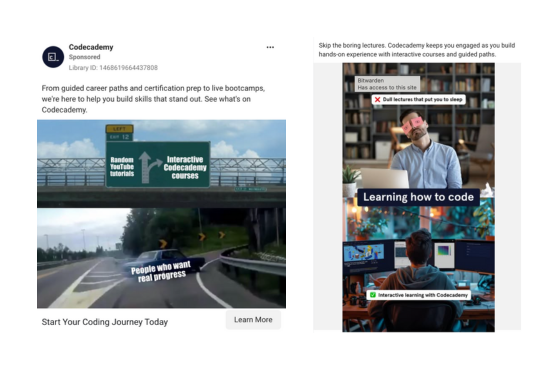
Codecademy ads

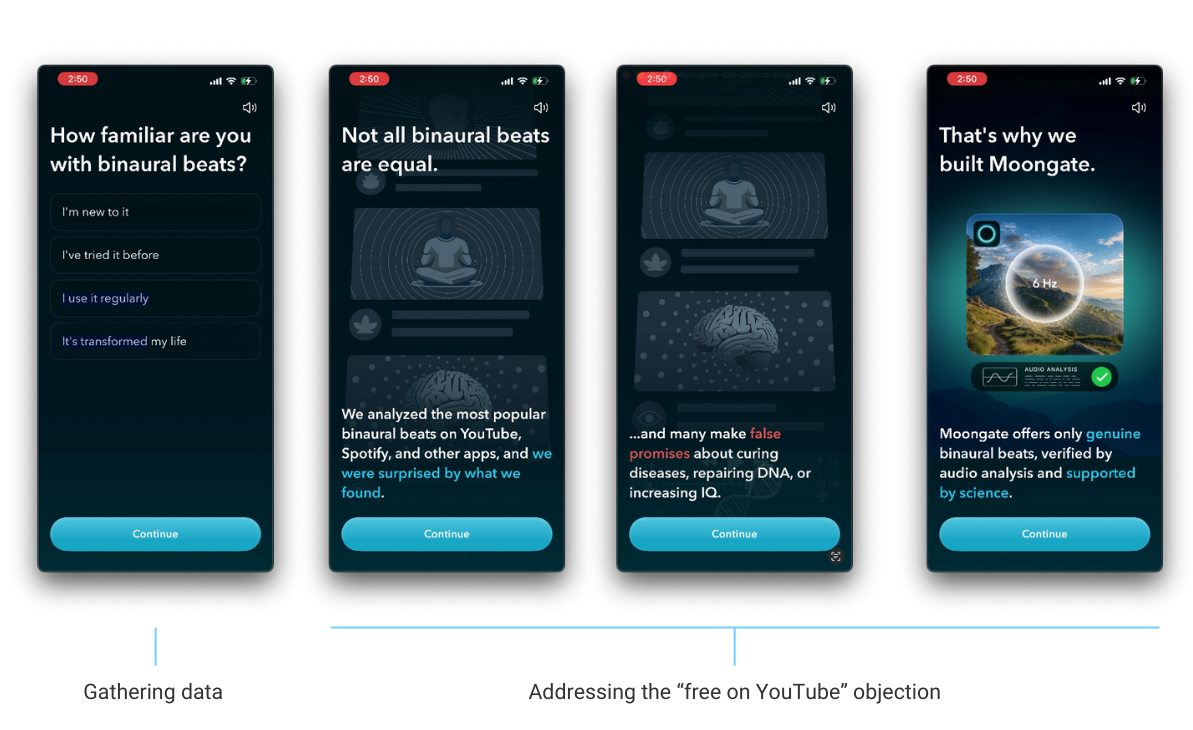
This can also be communicated during onboarding:

User Research

User Research

In our research, we pull out people who downloaded the app and then churned, or took one class and then churned. And we spend a lot of time talking to them because even though we want to build the app for the people who love Zumba, we also want to make sure that we're letting people engage with the product enough to find the love for it.

"We spend a lot of time looking at our data and pulling out specifically people that downloaded the app and then churned or took one class and then churned. And we spend a lot of time talking to those people as well because obviously we want to build the app for the people that love Zumba, but we also want to make sure that we're bringing people in and letting them engage with the product enough to find the love for it."

Optimizing Funnels, Pricing, and Retention at Zumba — Nicole Page & Lucy Levy, Zumba at 13:18 · Featured in Growth Gems #138

Sylvain's take:

Indeed, properly segmenting your user base isn’t just a nice-to-have but fundamentally shapes the quality of insights you get.

It’s easy (and, honestly, more comfortable) to spend time with power users who validate what you’re building and love what’s already working. But while power users tell you what’s working, churned users might tell you what’s broken. They share the mismatched expectations and the moments when your product promise breaks down.

To dig deeper into the user feedback topic, I recommend this guide on mining store reviews. No reviews to mine? Then maybe some of these tactics will come in handy.